
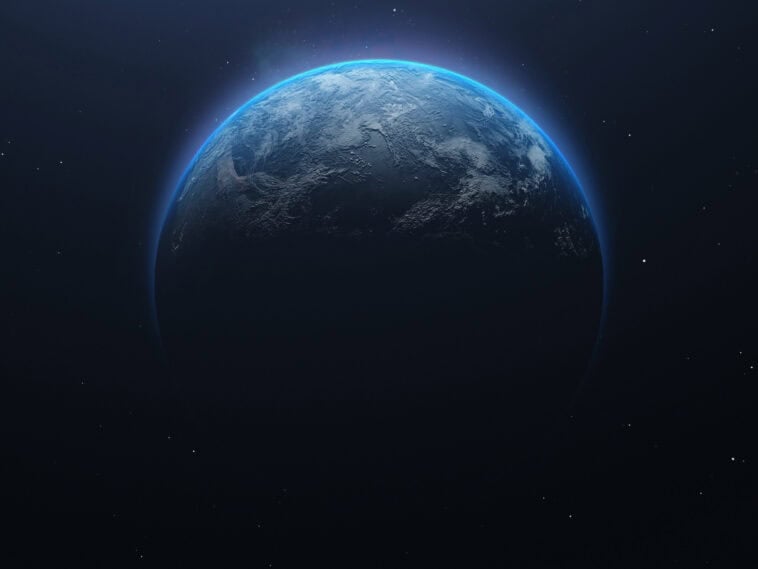
Turns out, Earth may be more of a local kid than scientists thought. A new study from ETH Zurich suggests the material that built our planet came almost entirely from the inner Solar System, rather than being a cosmic mix of ingredients from both sides of Jupiter. That finding challenges a long-running theory about how Earth was assembled.
Earth may have had a much more local origin
The question of where Earth’s raw ingredients came from has been debated for years. Some previous research suggested that between 6% and 40% of the material that formed Earth could have originated beyond Jupiter.
That theory also helped explain water. The outer Solar System contains plenty of water-rich and carbon-rich material. So if some of that material traveled inward while the planets were forming, it could explain how Earth ended up with the ingredients needed for its oceans and atmosphere.
But planetary scientists Paolo Sossi and Dan Bower took another look at the evidence. Instead of relying on just a couple of isotope systems, the ETH Zurich researchers analyzed data from 10 different isotope systems found in meteorites and compared them with Earth’s isotopic composition.
That dataset produced a surprising result. Earth appears to have formed from a single material reservoir in the inner Solar System. “Our calculations make it clear: the building material of the Earth originates from a single material reservoir,” Sossi said.
And Bower says the researchers were surprised by what they found. Earth’s composition didn’t match any combination of the meteorites associated with the outer Solar System.
Isotopes are basically cosmic fingerprints
Isotopes are versions of the same element that have the same number of protons but different numbers of neutrons. Because different parts of the young Solar System developed with different isotopic signatures, those ratios can act like cosmic fingerprints.
Scientists have been using meteorite isotopes for decades to figure out where different chunks of space rock originated. For a long time, oxygen isotopes did most of the detective work. Then researchers discovered that elements such as chromium and titanium could also help distinguish between material formed in different regions.
That led scientists to broadly divide meteorites into two groups. Non-carbonaceous meteorites formed in the inner Solar System, while carbonaceous meteorites are richer in water and carbon and originated farther out. According to the new analysis, Earth belongs firmly in the first camp. The planet appears to have formed from non-carbonaceous material, with little to no evidence that large amounts of outer-Solar-System material were mixed in.
Jupiter may have been Earth’s cosmic bouncer
Why didn’t all this material mix together? Jupiter may have had something to do with it. As the young gas giant grew, its enormous gravity could have carved a gap through the disk of gas and dust surrounding the newborn Sun. That disk was pretty much the construction site where the planets were being assembled.
Jupiter may have been like a cosmic bouncer, keeping much of the outer Solar System’s material from crashing the inner-Solar-System party.
Scientists already suspected Jupiter played a role in separating the two reservoirs of planetary material. The new research suggests that barrier may have been remarkably effective. Very little material from beyond Jupiter appears to have made its way into the region where Earth formed.
Mars and Vesta have something in common with Earth
The findings don’t just say something about Earth. The researchers found that Earth’s material composition resembles that of Mars and the asteroid Vesta, suggesting these objects may have shared a similar local source of material.
They also suspect Mercury and Venus could follow the same pattern. There is just one problem: scientists don’t currently have rock samples from Mercury or Venus that can be analyzed in the same way. So for now, those planets remain a prediction rather than a confirmed part of the story.
Scientists still have a question to answer
If Earth didn’t get significant amounts of water-rich material from the outer Solar System, where did all of Earth’s water come from? The early inner Solar System was an extremely hot place. Yet somehow, Earth ended up with enough water to cover much of its surface.
The new study does not solve that mystery. Scientists now have to figure out how water and other volatile substances could have existed in sufficient quantities in the inner Solar System while Earth was forming. Sossi and his team plan to investigate exactly that question next.
So Earth’s origin story may have just gotten simpler in one respect and considerably more complicated in another.
Sources: Science Daily, The News