
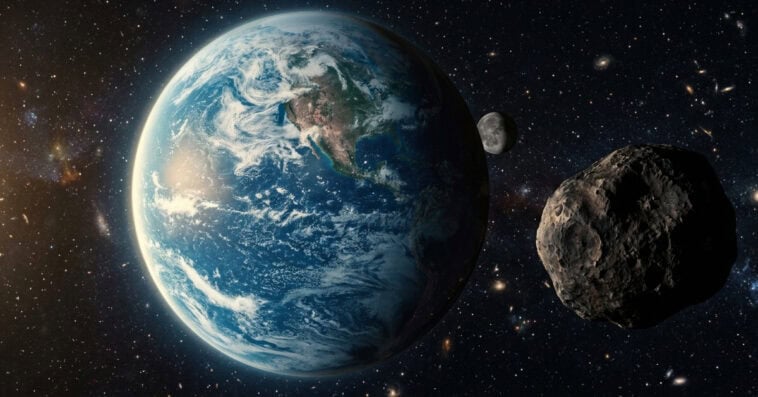
For years, a tiny space rock has been quietly following Earth on its journey around the Sun, hiding in plain sight as one of our planet’s mysterious cosmic companions. Now, for the first time, scientists have captured a close-up view of this so-called “second moon” — revealing new details about the strange object that has fascinated astronomers since its discovery. But while it may look like Earth has gained a new neighbor in space, the truth behind this unusual companion is far more surprising.
A high-stakes close encounter
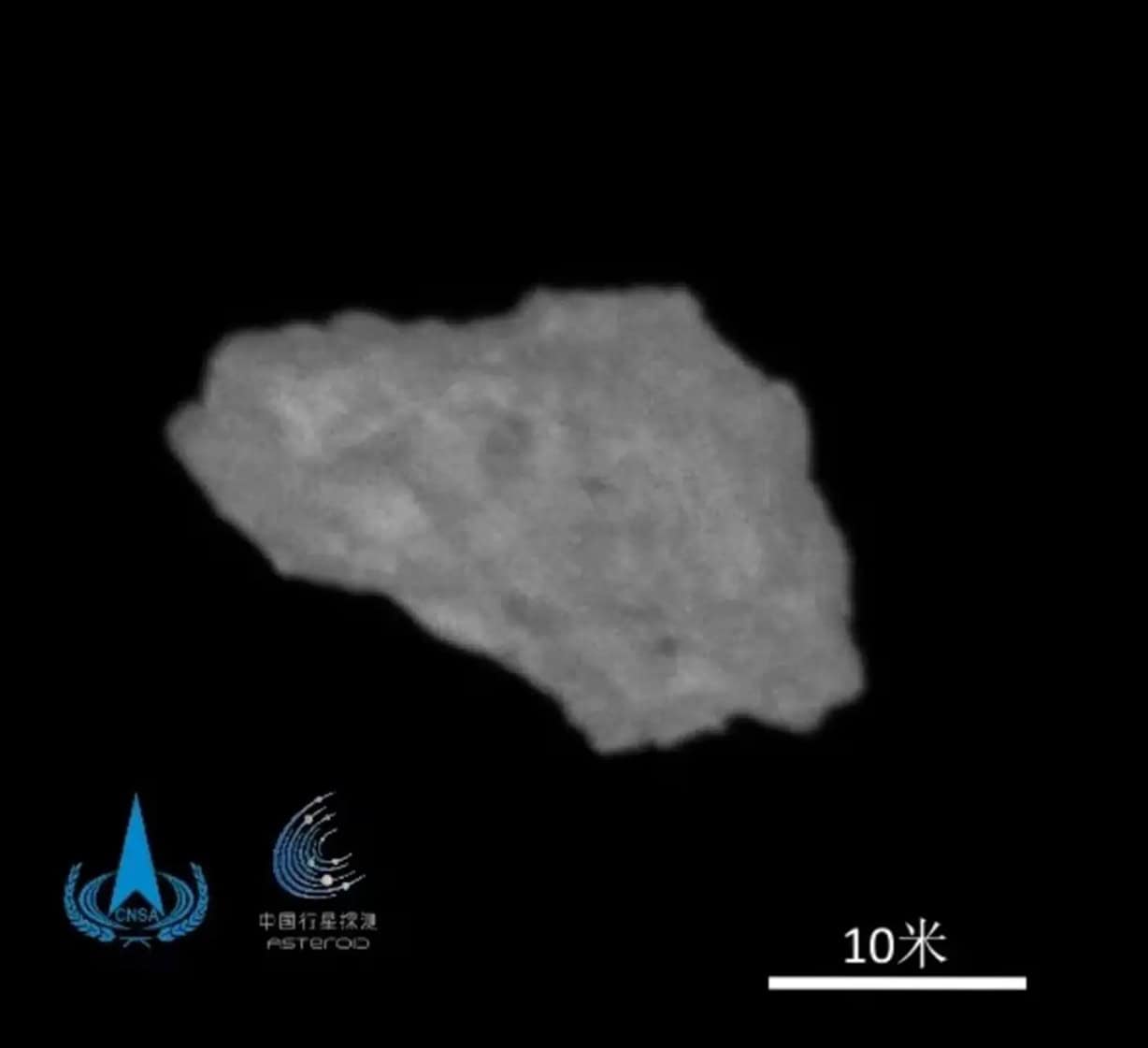
After journeying more than 600 million miles across space, China’s Tianwen-2 spacecraft reached its target this July: a jagged, fast-spinning space rock known officially as 2016 HO3 — or Kamoʻoalewa. For the first time in history, the China National Space Administration (CNSA) captured detailed close-up images of this elusive object, bringing our distant “mini-moon” into clear, startling focus.
The newly released photos show a dark, uneven fragment hurtling through the vacuum of space, giving Earthlings an unprecedented look at a world that has been quietly tagging along with our planet for decades.
What exactly is a ‘quasi-satellite’?
Despite being dubbed Earth’s second moon, Kamoʻoalewa isn’t actually locked into our planet’s gravitational grip the way our main Moon is.
Instead, it is classified as a quasi-satellite (or “quasi-moon”). Kamoʻoalewa primarily orbits the Sun, completing its journey once every 365 days or so. Because its path through space almost perfectly mirrors Earth’s own annual loop, it appears to gently circle our planet as both objects trek together around the Sun.
Every 45 years, it comes relatively close to Earth, although “close” is still a vast distance in space — the asteroid remains about 25.8 million miles away at its nearest approach.
Kamoʻoalewa is one of only seven known Earth quasi-satellites currently identified:
- 164207 Cardea (2004 GU9)
- 277810 (2006 FV35)
- 2013 LX28
- 2014 OL339
- 2023 FW13
- 2025 PN7
- 469219 Kamoʻoalewa (2016 HO3)
Among them, Kamoʻoalewa is the closest known example and has become one of the most fascinating targets for planetary scientists.
The long road to a historic snapshot
First discovered in 2016 by the Pan-STARRS 1 telescope in Hawaii, Kamoʻoalewa remained little more than a fuzzy dot on scientific displays for nearly a decade. Changing that required a massive engineering effort.
Launched from the Xichang Satellite Launch Center as part of CNSA’s ambitious sample-return initiative, the Tianwen-2 probe spent over 400 days navigating deep space to track the asteroid down. The timeline moved fast once the craft zeroed in on its target:
- June 6: Tianwen-2 made its very first visual lock on the asteroid.
- June 19: The probe closed the gap to within 1,242 miles.
- July: Moving to a razor-thin distance of just 12.4 miles (20 kilometers), Tianwen-2 snapped its historic close-ups.
“After a 400-day, one billion-kilometer journey, the Tianwen-2 probe recently made a successful encounter with asteroid 2016 HO3… During its approach to the asteroid, the probe acquired image data,” the CNSA confirmed in an official statement.
High-risk operations on a fast-spinning target
Capturing a clear photo was a triumph, but the hardest phase of the mission is just getting started. Tianwen-2 isn’t merely taking pictures; it intends to touch down, collect surface dust, and bring those samples back to Earth inside a specialized re-entry capsule later this year.
Executing a landing on Kamoʻoalewa is a thrilling, high-wire act for several reasons:
- Extreme diminutive size: Measuring somewhere between 138 and 328 feet across, Kamoʻoalewa is potentially the smallest asteroid ever visited by a human spacecraft.
- Rapid rotation: The asteroid tumbles violently through space, executing one full rotation every 28 minutes.
- Rough terrain: With virtually no flat landing strips and a bizarre, chaotic gravitational field, experts worry the spacecraft could accidentally bounce off the surface or lose its collected samples during contact.
To overcome these obstacles, engineers equipped Tianwen-2 with advanced hovering and specialized anchoring technology, allowing it to lock onto the volatile space rock long enough to scoop up material.
Unlocking mysteries of the solar system
Why go to such extraordinary lengths for a piece of space gravel?
For one, scientists suspect Kamoʻoalewa might not be an ordinary asteroid at all. Ground-based telescope analyses suggest its light spectrum matches the compositions found on our own Moon, raising the exciting possibility that this rock is actually an ancient piece of lunar debris blasted into space by an ancient impact.
Whether it proves to be a solid chunk of lunar crust or a loosely packed pile of cosmic rubble, analyzing its physical makeup could reshape our understanding of how near-Earth objects interact over time.
“Tianwen-2’s mission is far more complex than previous deep-space explorations and represents a completely new path for humanity’s exploration of the universe,” noted the CNSA.
If Tianwen-2 succeeds in stowing its cosmic cargo and returning it safely to Earth, researchers won’t just be examining a rare piece of space rock — they may end up holding a forgotten piece of our own celestial history.
Source:
New York Post