
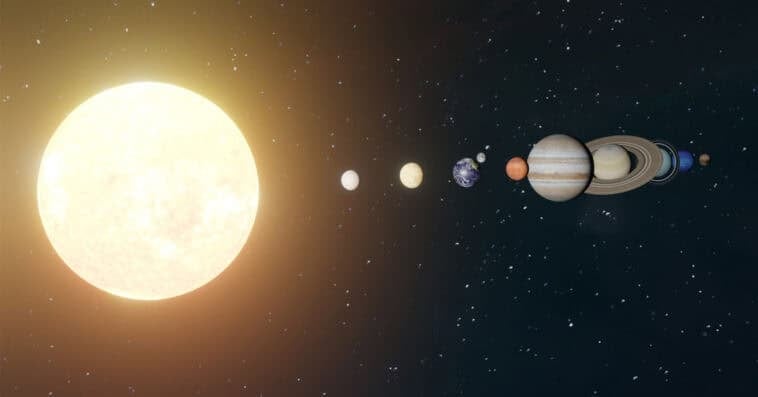
We usually think of our Solar System as a calm, well-organized family of planets, but a new study suggests its early days may have been far more chaotic. Instead of the four giant planets we know today, scientists think there may have once been six, meaning two massive worlds could have been kicked out of the Solar System entirely, drifting off into deep space. Even more surprising, researchers say clues to what happened may be hidden in the moons of Uranus, hinting at a story that doesn’t quite fit existing theories. The findings are challenging what we know about how our cosmic neighborhood formed—and raising new questions about where those lost planets might have gone.
Our Solar System may be hiding a violent past
For thousands of years, humanity has looked at the night sky and found comfort in its predictability. The planets whirl around the Sun like clockwork, lined up in a neat, orderly row. It is one of the ultimate constants of human existence.
But our cosmic neighborhood wasn’t always this peaceful.
A fascinating new study suggests that billions of years ago, our solar system was actually a crowded, chaotic pinball machine that may have been home to two extra giant planets. However, when scientists tried to trace the footsteps of these lost worlds, they ran into a massive problem. The evidence left behind suggests that our solar system’s history was either a story of pure, unbelievable luck—or a tale of absolute planetary destruction.
The Nice model
To understand how we might have lost two planets, astronomers rely on a famous framework called the Nice model (named after the city in France where it was developed in 2005).
Scientists believe that when our solar system was in its infancy, it was a messy, crowded place. As the giant planets moved through a thick disk of space debris, their massive gravity values tugged at one another, triggering a period of intense instability.
In its most modern versions, the Nice model suggests the outer solar system actually started with five or six giant planets instead of the four we know today (Jupiter, Saturn, Uranus, and Neptune). According to the model, as these giants shifted around, they stirred up gravity storms. Eventually, the four planets we see today settled into their current orbits, while the two extra “ice giant” worlds were violently kicked out into the deep, dark void of interstellar space.
For years, this model worked beautifully to explain the broad strokes of our space history, including why the outer solar system looks the way it does today. But astrophysicist Matthew Clement of Johns Hopkins University and his team wanted to look closer. They wanted to know: if two massive planets were evicted from our solar system, what did that chaos do to the moons left behind?
The baffling clue in Uranus’ moons
To find out, the research team set up a massive digital simulation playground. They ran a wide spectrum of possibilities to see how the moons of Jupiter and Uranus would handle the gravitational mayhem of losing two sibling planets.
The results, published in the journal Icarus, revealed a glaring problem.
While Jupiter’s moons managed to survive the chaos relatively unbothered, Uranus’s moons were absolutely devastated in almost every scenario. The gravity from the passing planets caused Uranus’s moons to violently crash into each other, get thrown out into space, or have their orbits completely scrambled.
Yet, when we look at Uranus today, its major moons are perfectly intact, orbiting neatly on the exact same flat plane around the planet’s equator. Leaving both Jupiter and Uranus’s moon systems perfectly intact during a planetary eviction turned out to be nearly impossible.
Three possible explanations
This leaves scientists with a major cosmic detective riddle. According to Clement’s team, we are now left with three potential explanations for how our solar system ended up looking so neat today:
“These results have three potential implications,” the team writes. “One, the Uranian satellites were destabilized to the point of collisions a few times during this turbulent time. Two, the current version of the Nice model needs revising; or three, ‘the Solar System is the result of fairly unlikely instability evolution that entailed almost no deep encounters between Uranus and the other giant planets.’”
If the first option is true, it means Uranus’s current moons are actually “second-generation” moons — born from the graveyard of ancient moons that destroyed each other. If that’s the case, Uranus was bullied by the universe at least twice: first by an impact that flipped the planet completely on its side, and second by the chaos that smashed its original moons to pieces.
If the third option is true, our solar system took a highly improbable, incredibly lucky evolutionary path where the giant planets somehow missed hitting Uranus entirely.
Of course, there is always the chance that our current scientific models are simply incomplete, which isn’t surprising when you are trying to reconstruct a crime scene that took place 4 billion years ago.
“It is highly likely that none of the modeled instabilities in the literature contain the precise sequences of encounters necessary to exactly reproduce all aspects of the Solar System,” the researchers explain. “While it is certainly possible that all four primordial regular satellite systems in the outer Solar System were unaffected by planetary encounters, our results strongly suggest that this is not the case.”
What comes next
Rather than closing the case, the study adds another layer to one of astronomy’s biggest puzzles. It suggests that scientists may need to refine existing models — or consider more complex and violent histories — to fully explain how the Solar System reached its current shape.
The research reinforces a growing idea in planetary science: the Solar System’s past may have been far less stable, and far more dramatic, than the peaceful arrangement we see today.
Sources: Icarus, Science Alert