
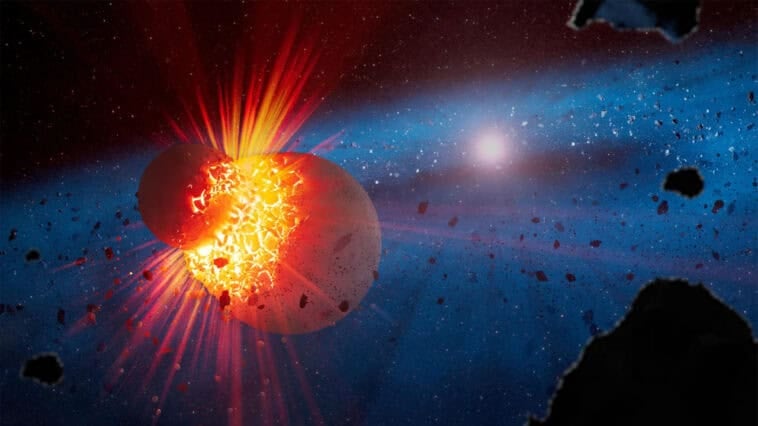
NASA’s James Webb Space Telescope is giving astronomers a remarkable look at what happens when young worlds collide. By studying unusual clouds of warm dust around young stars, researchers have found clues that rocky planets may undergo enormous impacts similar to the collision that helped create our own Moon. The findings could offer a rare glimpse into the violent processes that shaped Earth and other rocky planets. Read on to discover what Webb found and what these cosmic collisions could reveal about the early history of our solar system.
Webb finds rare signs of planetary collisions
The violent collisions that helped shape our solar system may not have been unique to Earth. NASA’s James Webb Space Telescope is now giving astronomers a closer look at young star systems where similar impacts may be taking place.
The systems contain what scientists call extreme debris disks, which are clouds of dust surrounding young stars that contain unusually large amounts of warm material. The dust sits relatively close to the stars, in a region comparable to where rocky planets orbit in our solar system.
These disks are thought to represent a stage in planetary development. Young stars initially have gas-rich disks where planets form. As those systems age, much of the gas disappears, leaving behind debris produced by collisions between planetary bodies.
Extreme debris disks are surprisingly uncommon. Scientists estimate that only about 1% of young stars show observable evidence of this stage, although our own solar system may have gone through it in the distant past.
A team led by Kate Su of the Space Science Institute in Boulder, Colorado, studied 21 such disks. Five came from observations made by NASA’s retired Spitzer Space Telescope, while Webb examined 16, including 12 newly observed systems.
“This is the first time we have gathered enough systems to truly understand this subclass that we call extreme debris disks,” said Su, lead author of the paper. “Before Webb, we had limited information. We knew that they are weird and very different from the typical cold debris disks that we know, like Vega and Fomalhaut. Now that we have more data, we can pin down what these disks represent for planet formation and evolution.”
Dust holds clues to violent impacts
Using Webb’s mid-infrared instruments, the astronomers identified three distinct traits defining these extreme disks: microscopic dust grains, unusually high concentrations of warm material, and irregular fluctuations in brightness over time.
By analyzing the light spectra emitted by the dust, researchers divided the 21 systems into two distinct mineral groups:
- Silica-rich disks: Containing materials similar to volcanic glass (like obsidian found on Earth), making up roughly one-third of the sample.
- Silica-poor disks: Containing minerals like forsterite (seen in Hawaii’s green sand beaches), accounting for the remaining two-thirds.
This chemical breakdown provides direct evidence of the types of planetary crashes occurring in these distant systems.
“To just see their mid-infrared emission and beautiful spectral features with Webb, which allowed us to identify their compositions, was the most exciting thing for me,” said Agnes Kospal of Konkoly Observatory in Budapest, Hungary, and a coauthor of the study. “We have no other way to study these planetary embryos directly because they are too small.”
Mars-sized worlds could be colliding
About one-third of the disks studied were silica-rich. According to the researchers, these systems likely formed after extremely powerful collisions involving Mars-sized planetary bodies. The impacts could have generated enough heat and energy to vaporize large amounts of rock.
The remaining two-thirds were silica-poor and appear to have been produced by less energetic impacts, potentially involving Moon-sized objects that struck each other at a grazing angle.
Age also appears to be important. Silica-rich disks have so far been found only around stars younger than 300 million years, while silica-poor disks occur around stars covering a much broader range of ages.
“How rocky planets formed and giant planets evolved are part of the broader story of the solar system’s formation. It’s all one story,” said Su. “Our work on extreme debris disks helps us bring together the big picture of what we currently understand.”
Could this explain how the Moon formed?
Computer models suggest rocky planets can form within the first few hundred million years of a solar system’s development. That matches the ages of the silica-rich disks observed by Webb.
It also fits with the leading explanation for the origin of the Earth’s Moon. Scientists believe Earth was struck by a Mars-sized body called Theia roughly 100 million years after the Sun formed. The enormous impact may have blasted rock into space, with some of that material eventually coming together to form the Moon.
The researchers caution that much remains unknown.
“Of course, there’s many things we still don’t know about these disks,” said Attila Moor of Konkoly Observatory, a coauthor of the study. “We expect no silica-rich systems among older extreme debris disks. We only have three disks in our sample that fit that age criteria, so it’ll be nice to observe more of these systems to confirm our hypothesis.”
Source:
Science Daily