
For decades, scientists have searched for worlds beyond Earth that might contain the ingredients for life, and one of the most intriguing places has been hiding in plain sight. New research suggests Jupiter’s icy moon Europa may hold a massive underground ocean with more liquid water than Earth’s own oceans, raising fresh questions about what could be lurking beneath its frozen surface. But how can a moon covered in ice maintain such a vast supply of liquid water, and could this hidden ocean make Europa one of the most promising places to search for life beyond our planet?
A frozen surface hiding a massive ocean
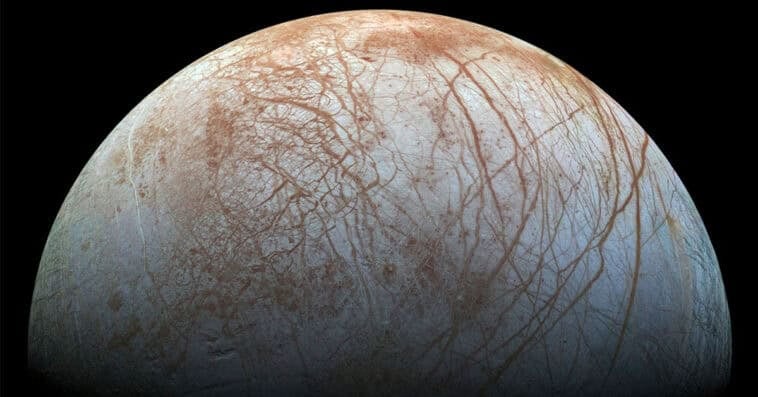
From space, Europa appears to be nothing more than a cracked, frozen cue ball. Slightly smaller than Earth’s Moon, its surface is painted with rust-colored scars and strangely devoid of deep impact craters. Yet behind this chilly facade lies an astonishing secret. Scientists believe a vast, salty ocean hides beneath its outer shell—one containing roughly twice the volume of all Earth’s oceans combined.
How can a moon so small hold so much water? The answer comes down to pure depth. While Earth’s oceans cover a massive area, they average only about 3.7 kilometers (2.3 miles) deep. Europa’s hidden sea, by contrast, is estimated to plunge a mind-boggling 100 kilometers (62 miles) down, wrapping around the entire moon beneath an ice crust that is anywhere from 3 to 30 kilometers thick.
Scientists found clues without seeing the ocean
Because no human or probe has ever drilled through Europa’s icy shell, scientists have had to play detective from afar. The strongest evidence came in the 1990s via NASA’s Galileo spacecraft, whose magnetometer — an instrument used to measure magnetic fields — detected a unique magnetic signal surrounding the moon.
As Europa travels through Jupiter’s immense magnetic field, electrical currents are induced within the moon. The most logical conductor capable of creating this effect? A global layer of salty liquid water.
Europa’s jumbled surface offers further proof. Across its face lie wide fractures and “chaos terrain”—scrambled blocks of ice that look like icebergs that broke apart, shifted, and froze back together. The lack of ancient craters suggests the surface is continually being renewed, hinting that a warm, active layer underneath is constantly reshaping the exterior.
Jupiter’s gravity keeps Europa’s ocean from freezing
In the deep freeze of outer space, Europa’s ocean should be solid ice. So what keeps it liquid? The short answer is Jupiter’s colossal gravity, but the actual process is a masterclass in cosmic physics.
Europa follows an oval-shaped, off-center orbit around Jupiter. As it moves closer and farther away during its 3.5-day journey, Jupiter’s gravitational pull constantly expands and compresses the moon. This relentless stretching and flexing, known as tidal flexing, acts like bending a paperclip back and forth until it gets hot to the touch. The internal friction generates massive amounts of thermal energy.
Normally, these forces would circularize Europa’s orbit over time, shutting down the heat source. However, Europa is caught in a gravitational dance called orbital resonance with two neighboring moons, Io and Ganymede. For every single orbit Ganymede completes, Europa completes two, and Io completes four. Their steady gravitational nudges keep Europa’s orbit off-center, powering a continuous internal engine.
Could Europa’s ocean contain life?
Sunlight barely reaches Jupiter, and it certainly cannot penetrate kilometers of solid ice. Europa’s ocean exists in total, perpetual darkness, ruling out sunlight-dependent photosynthesis.
Yet, darkness is no dealbreaker for life. Deep on Earth’s ocean floor, entire ecosystems flourish around hydrothermal vents — underwater hot springs powered by chemical reactions rather than sunlight. Europa may share similar geology, with hot underwater vents or chemical exchanges where the seabed meets rock.
Additionally, harsh radiation from Jupiter constantly splits surface ice molecules into oxidants. If these chemicals trickle down through surface cracks, they could deliver vital metabolic fuel to the waters below.
Europa Clipper aims to unlock the moon’s secrets
While Europa boasts all the right ingredients — liquid water, energy, and key chemistry — a habitable environment does not guarantee that life actually exists there.
To solve this cosmic mystery, NASA’s Europa Clipper spacecraft is currently making its way to the Jupiter system. Arriving in 2030, Clipper will perform 49 low-altitude flybys, dipping as close as 25 kilometers (15 miles) above the icy surface. Armed with ice-penetrating radar, high-resolution cameras, and advanced spectrometers, the probe will map the moon’s composition, measure ice thickness, and scan for potential plumes of water bursting into space.
Clipper won’t land or search directly for alien organisms. Instead, it will finally confirm whether this dark, distant sea possesses the spark needed to sustain life.
Source:
Space Daily