
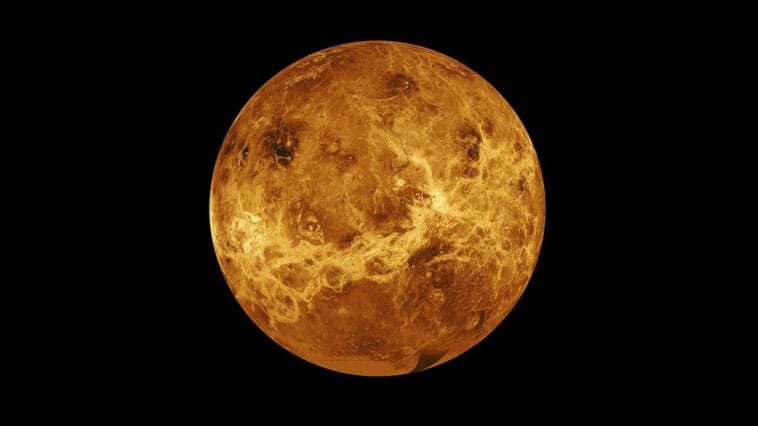
Venus may be hiding a dramatic chapter in its ancient history. A new study now suggests that the planet could have once been accompanied by a moon, only for its sluggish rotation to gradually pull the lunar body closer until Venus ultimately swallowed it. The idea offers a possible explanation for why Earth’s planetary neighbor is moonless today, while also challenging assumptions about how moons form, evolve, and disappear. But how could a moon fall into its own planet, and what does this reveal about Venus’ mysterious past?
A tale of two spins
For decades, planetary scientists have puzzled over why Earth has a prominent lunar companion while Venus — often called Earth’s twin because of its similar size, mass, and structure — stands entirely alone. Previous theories suggested Venus either never had a moon-forming impact or lost its moon to a subsequent asteroid collision. However, a study published in The Astrophysical Journal suggests a far simpler mechanism.
“My study shows Venus didn’t require a catastrophe to arrive at what we can see today,” said lead author Stephen Kane, an astrophysicist at UC Riverside. “It turns out the gravity of the planet itself combined with the rate at which it spins naturally caused the moon to collapse on top of it.”
The stark difference lies in how fast each planet rotates:
- Earth: Spins rapidly, completing one rotation every 24 hours. Thanks to lasers reflected off mirrors left by the Apollo 11 mission, scientists know Earth’s rotation transfers energy to our Moon, pushing it outward at about four centimeters per year.
- Venus: Takes a sluggish 242 Earth days to complete just one rotation. Lacking the rotational speed to push a satellite away, Venus’s gravitational forces would pull an orbiting moon closer over time, setting off a slow-motion orbital decay.
Surprising computer models
To test this tidal mechanics theory, Kane ran gravitational simulations, first validating his model against the Earth-Moon system before applying it to Venus with hypothetical moons ranging from half to ten times the mass of our own Moon.
The results were astonishingly consistent across nearly every variable: the moons inevitably spiraled inward and crashed into the planet, with larger moons falling even faster.
“When I made this discovery, I was shocked,” Kane said. “I thought surely the broad range of scenarios I was exploring would lead to a variety of results. But it all went pretty much in the same direction.”
While the simulations do not prove Venus definitively had a moon, they demonstrate that any moon orbiting Venus was doomed to a finite lifespan.
Hidden clues and planetary consequences
Detecting physical evidence of an ancient collision poses a unique challenge. Roughly 80% of Venus’s surface was overwritten by a massive volcanic resurfacing event about a billion years ago, likely erasing surface craters.
However, evidence could be preserved deep within the interior. On Earth, seismic instruments have detected massive, unusual mantle structures believed to be remnants of the giant impact that created our Moon. Similar seismic probes on future Venus missions could reveal if remnants of an absorbed moon lie buried near its core.
If a collision occurred, the energy and angular momentum delivered by the impact would have radically altered Venus:
- Climate & Geology: The sheer heat of an absorbing moon could have transformed Venus’s atmosphere and surface, potentially ending an early, hospitable era when oceans may have existed.
- Rotational Dynamics: A collision would have permanently altered the planet’s spin and geological progression.
Implications for alien worlds
These findings extend far beyond our solar system as astronomers search for habitable exoplanets orbiting distant stars.
“My feeling is there are benefits to having a moon, but it isn’t required for habitability,” Kane explained. “The moon has definitely changed the way Earth has evolved through time, but we don’t fully know how important that role is.”
Ultimately, the study warns scientists searching for “Earth twins” deep in space: generating a moon is only half the battle — a planet must also spin fast enough to keep it.
“When people think about Earth twins around other stars, one question they ask is, ‘Does it have a moon?'” Kane said. “My study shows a disturbing scenario for many of those cases. If these planets don’t rotate fast enough, the moon will crash to the surface, and that would change the course of history for those planets.”
Source: ScienceDaily