
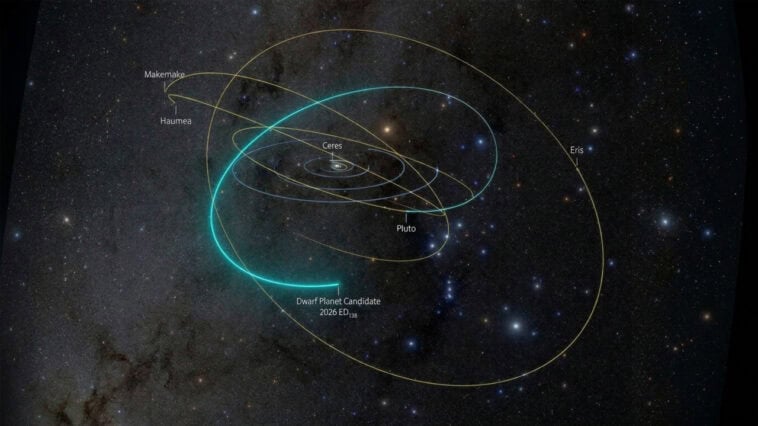
Pluto may have a new neighbor that could change what we know about the outer solar system. Scientists have identified a massive dwarf planet candidate far beyond Neptune that could be one of the largest known objects in this distant region. The discovery offers a glimpse into a largely unexplored part of our solar system, raising new questions about how these icy worlds formed and evolved. But how big is this mysterious object, and what makes it stand out among the countless bodies orbiting the Sun? Read on to find out what scientists have uncovered and why this discovery matters.
Astronomers have identified a new dwarf planet candidate beyond Pluto, provisionally named ED138. If confirmed, it could become the sixth officially recognized dwarf planet in our solar system, joining Ceres, Pluto, Haumea, Makemake, and Eris.
The icy candidate is classified as a trans-Neptunian object (TNO) — a body in our solar system that orbits the Sun at a greater average distance than Neptune. Right now, ED138 sits about 46 astronomical units (AU) from the Sun (where 1 AU equals the distance between Earth and the Sun). That places it well past Pluto.
Scientists estimate ED138 spans between 600 and 1,500 kilometers (370 to 930 miles) in diameter. If those figures hold up, it will easily outsize Ceres, the smallest recognized dwarf planet.
How astronomers found ED138
The groundbreaking discovery was made using the Vera C. Rubin Observatory in Chile. Perched atop an 8,800-foot mountain, the facility houses the world’s largest digital camera and can scan the entire visible sky every three days.
While sifting through Rubin data collected in early 2026, Matthew Holman — a senior astrophysicist at the Smithsonian and Harvard University lecturer — noticed something extraordinary moving across the screen.
When ED138 popped up, Holman said he first reacted with “excited disbelief,” immediately checking for a false positive or a software glitch.
To verify the hit, Holman collaborated with Mario Jurić, the Rubin Solar System lead scientist and an astronomy professor at the University of Washington. Jurić uncovered 20 additional sightings of ED138 in Rubin’s archives from March 2026. By pulling from other astronomical data sources, the team managed to trace the object’s orbital path back a full decade.
Why did it take so long to find?
Despite its massive size, ED138 managed to slip past researchers for decades due to two major factors:
- Location: ED138 orbits in the southern sky, making it nearly invisible to northern hemisphere observatories. “That already rules out whole sets of telescopes that might have found this, and there aren’t as many telescopes searching the sky in the southern hemisphere,” Holman noted.
- Background Camouflage: The object was traveling directly against the dense backdrop of our galaxy. “For the last 20 years, the object has kind of been looping its way across the Milky Way, from our point of view,” Holman explained. “People don’t typically search for things in the Milky Way, because there’s so many stars that it’s really hard to find moving objects.”
Though invisible to the naked eye, Holman noted that ED138 “is bright enough that really capable amateurs can see it if they know where to look.”
Could ED138 become an official dwarf planet?
The International Astronomical Union (IAU) established its modern definition of a planet in 2006. Under its criteria, a planet must orbit the Sun, be nearly round because of its own gravity, and have cleared its orbital neighborhood of other objects of comparable size.
Pluto failed to meet the final requirement and was reclassified as a dwarf planet, reducing the number of recognized planets in our solar system from nine to eight.
Dwarf planets are nearly round objects that orbit the Sun but have not cleared their orbital neighborhoods.
If ED138 meets the necessary criteria, astronomers will assign it a permanent number before giving it an official name. The naming process could take time, and it remains unclear who will ultimately choose the name.
“People have already emailed me some suggestions, and some of them are already taken by other objects,” Holman said. “I don’t know. It’ll be fun. Maybe I’ll get to suggest something, but I’m not going to hold my breath, because this is a big, big project.”
What could ED138 reveal about the outer solar system?
Michele Bannister, an associate professor at the University of Canterbury in New Zealand who was not involved in the discovery, described ED138 as an exciting find because of its size and distant location.
The object is “scientifically really cool because it’s a trans-Neptunian object and it’s also physically quite large, but still a lot fainter than you can see with the naked eye,” Bannister said.
Its estimated size places it in a range where scientists can begin considering it a distinct world rather than simply a small icy body. Follow-up observations using other telescopes should help researchers determine its physical properties.
Bannister also raised the possibility that ED138 could have features similar to Pluto, although scientists have not yet gathered enough information to know.
“Maybe if we ever fly a spacecraft there, we’ll find it has a nitrogen glacier like Pluto,” Bannister said. “That would be great to see. But at the moment, all we know is that it’s big, and the rest is going to be speculation for a little bit, about what its physical characteristics really are.”
ED138 is among the growing number of solar system objects detected by the Rubin Observatory, which has been identifying asteroids and smaller trans-Neptunian objects.
Holman believes there could be “a handful” of other objects comparable in size to ED138 waiting to be discovered.
Megan Schwamb, a reader in astrophysics at Queen’s University Belfast and a member of the observatory’s Solar System Operations team, said the discovery demonstrates the telescope’s potential.
“Rubin Observatory is just doing its job really well, inventorying the Solar System to new depths,” Schwamb said in an email.
“I was surprised that it found such an object so early in the commissioning observations. This was not on my bingo card for this year,” she added. “It shows how Rubin’s combination of speed, depth, and sky coverage is going to transform our view of the Solar System over the next decade and especially in the next few years.”
The observatory’s ability to scan large portions of the sky repeatedly could help astronomers build a more complete picture of the distant solar system and identify worlds that previous surveys overlooked.
Source:
CNN