
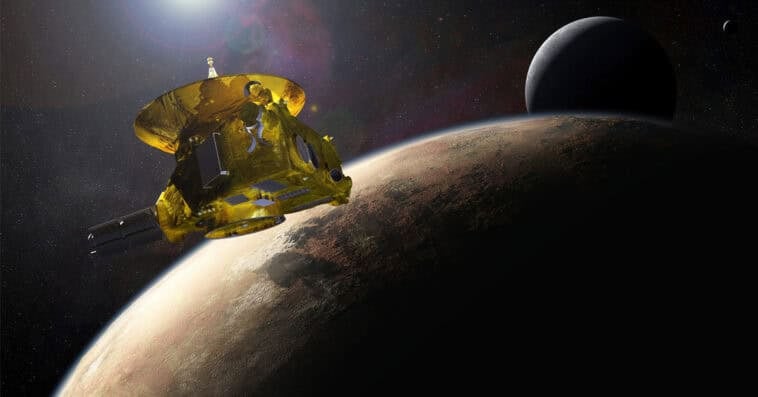
Just when it seemed humanity’s most distant planetary explorer had gone quiet once again, NASA’s New Horizons spacecraft has awakened 6 billion miles from Earth, well beyond Pluto’s orbit. The timing is no coincidence. Scientists have switched the probe back on for a reason, and its next mission could shape our understanding of an unexplored frontier that few spacecraft have ever reached.
Sleeping on the long journey outward
Deep-space exploration requires a rare blend of speed and patience. Because the vast stretches between cosmic landmarks are largely empty, spacecraft like New Horizons often spend months cruising on autopilot. To conserve energy and minimize wear on its components, mission operators put the probe into a low-power “hibernation” mode.
During these naps, the spacecraft shuts down most of its operational systems while leaving its scientific sensors on low, quietly gathering background information.
New Horizons slipped into its latest slumber in August, drifting silently for 321 days. Now, mission controllers at the Johns Hopkins Applied Physics Laboratory (APL) have confirmed that the probe is fully awake and checking in in pristine condition.
“Every status report through this hibernation period was ‘green,’ meaning all was well aboard New Horizons each and every week,” said Alice Bowman, the mission operations manager at APL.
At a staggering distance of 5.9 billion miles (9.5 billion kilometers) from Earth, simple communication is a monumental feat. Even travelling at the speed of light, a radio signal sent from the probe takes roughly nine hours to reach dish antennas on Earth. The spacecraft’s immediate priority is downloading the trove of environmental data recorded during its 10-month rest and delivering full diagnostic reports on its internal hardware.
From Pluto’s heart to the ‘snowman’ in the dark
This isn’t the first time New Horizons has made history. Launched to explore the uncharted outer limits of our planetary family, the resilient spacecraft became the first—and so far only—visitor to fly past Pluto in 2015, revealing a shockingly dynamic world of nitrogen ice glaciers and rugged mountains.
Four years later and another billion miles deeper into the dark, the probe pulled off a second historic encounter: a close flyby of Arrokoth, a strange, snowman-shaped planetesimal (a primitive building block of early planets).
Since those historic encounters, New Horizons has been speeding away from Earth at a brisk rate of 300 million miles per year. It is currently navigating the Kuiper Belt — a vast, frozen donut-shaped ring populated by millions of icy rocks left over from the formation of our solar system beyond Neptune.
Probing the edge of interstellar space
Now that it’s wide awake, New Horizons is setting its sights on an invisible front line: the heliosphere. This is the giant protective “bubble” created by the solar wind, a constant stream of charged particles blowing outward from our sun.
In a few weeks, the probe will kick off a targeted experiment measuring hydrogen gas floating near the termination shock — the turbulent outer boundary where the sun’s solar wind collides with the dense, interstellar gas of deep space.
While NASA’s iconic Voyager 1 and Voyager 2 spacecraft were the first human objects to cross this cosmic frontier, New Horizons brings a significant upgrade to the search. Built decades after the Voyagers, it carries modern, high-sensitivity instruments capable of analyzing this realm in ways its predecessors simply couldn’t.
“The data from the termination shock encounter will be a treasure trove for space physicists worldwide who are eager to understand how this vast boundary works,” explained Pontus Brandt, a New Horizons project scientist at APL. “All these discoveries from pioneering missions like Voyager and New Horizons teach us how little we know about what lies beyond.”
How long can New Horizons keep running?
New Horizons is expected to remain scientifically useful well into the 2030s, although the exact end date depends on how quickly its power supply declines and how NASA chooses to manage the spacecraft’s systems. The probe is powered by a radioisotope thermoelectric generator, a “nuclear battery” that gradually produces less electricity over time as its plutonium fuel decays.
NASA extended the mission through the spacecraft’s journey out of the Kuiper Belt, which is expected to continue until roughly 2028–2029. However, that is not necessarily the end of operations. Mission planners have discussed continuing heliophysics and astrophysics observations beyond that point as long as sufficient power and funding remain available. Some projections have suggested the spacecraft could continue returning valuable scientific data into the late 2030s.