
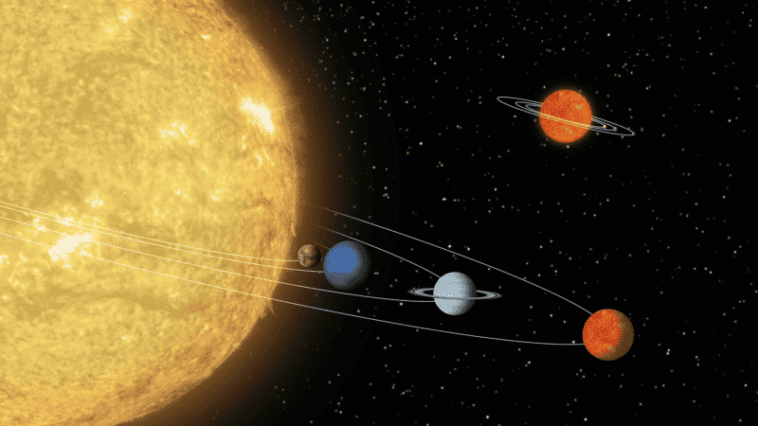
The solar system may fall apart about a billion times sooner than scientists expected, according to a new study.
The research focuses on what happens once the Sun burns out. In roughly eight billion years, it will become a white dwarf, cooling and shrinking until it holds a little over half its current mass.
While earlier studies assumed the outer planets would ride that out, with orbits staying stable for something close to a quintillion years, that figure relied on the Sun shedding mass smoothly and steadily.
The new paper, led by researchers at Caltech (California Institute of Technology) and published in The Astrophysical Journal Letters, argues it won’t.
Instead, the authors say, the Sun will likely throw off material in bursts that come at random times and in random directions. Each burst will give the planets a small kick. Enough of those kicks can push the outer planets, Jupiter and Saturn among them, off their orbits.
Under that model, the solar system lasts about a billion years after the Sun becomes a white dwarf, not a billion billion.
Yet in some cases the system does not even make it that far and reach the white dwarf stage intact. In 40% of the team’s simulations, the planets were scattered or knocked loose while the Sun was still a red giant.
The finding loops back to an old idea. Isaac Newton worried that the gravitational balance between Jupiter and Saturn would eventually unravel the solar system, and more recent work had largely dismissed that concern. The researchers, however, say their results point to something else entirely: “not the slow seep of chaos, nor the chance encounter with a passing star, but the Sun itself.”
That same process, the way the Sun sheds its mass, also reframes a more optimistic finding published earlier this year. In a separate study in Astronomy & Astrophysics, researchers at Belgium’s KU Leuven concluded that Earth might escape the dying Sun as the star loses mass, its gravitational grip weakens, and our planet drifts into a wider, safer orbit.
Ultimately, both findings turn on the same question: how the Sun loses its mass. June’s answer was a slow, steady drain, gentle enough for Earth to slip away. The new paper finds the opposite: abrupt, violent losses, and it’s those losses that rattle the outer planets loose.
None of this should worry anyone on Earth because long before the Sun becomes a white dwarf, it will swell into a red giant hot and bright enough to wipe out all life here, and it may swallow the planet outright.
Sources: The Astrophysical Journal Letters, AAS Nova, Astronomy & Astrophysics, Institute of Astronomy. Independent