
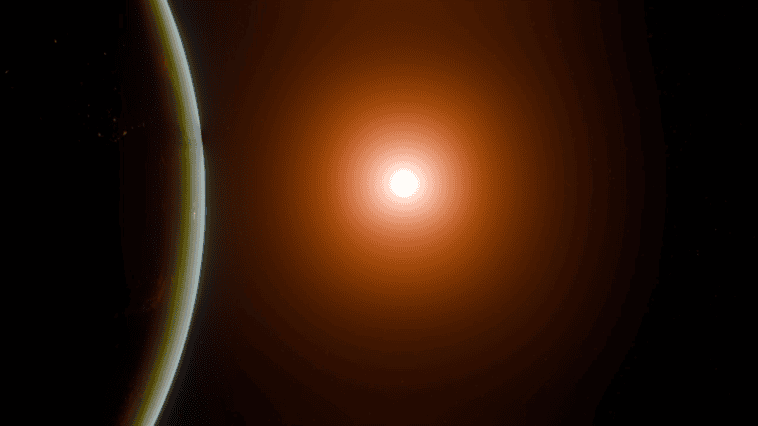
The Sun has had a five-billion-year sentence hanging over Earth, but a new study suggests that it might never be carried out.
That long-standing fate in which our planet would be swallowed up by the expanding fireball when the star dies is now being challenged. New research published recently in the journal Astronomy and Astrophysics suggests Earth might actually slip away.
A celestial tug-of-war
The Sun’s evolutionary timetable is unchanged by the new findings. Five billion years from now, give or take, the Sun will burn through the hydrogen in its core and begin a dramatic, two-stage expansion. First, the star will swell into a red giant, then, after its helium runs out, it will become an even bigger and stranger object called an asymptotic giant branch (AGB) star.
What happens to Earth during this process depends on a tug-of-war between two opposing forces.
On one side is gravity working through tides. As the Sun grows larger and more massive, its gravitational pull on Earth would strengthen, much like the force responsible for the tides in our oceans. The energy dissipated by these tides on the ocean floor gradually slows Earth’s rotation and pushes the Moon farther away over time.
A dying, swelling Sun would trigger something similar but on a much more violent scale. Dynamical tides powered by internal gravity waves stirred within the star itself would dissipate energy in a way that drags Earth in closer and eventually consumes it.
On the other side is mass loss. As the Sun ages and expands, it sheds material through what astronomers call stellar wind. The lighter the Sun gets, the weaker its gravitational grip becomes, effectively allowing Earth’s orbit to drift farther out.
“Earth’s fate depends on a delicate balance between these two effects,” Mats Esseldeurs, the lead author of the study and an astrophysicist at Belgium’s University of Leuven, said in a statement. “If tidal interactions predominate, Earth is engulfed by the Sun. If the Sun’s mass loss predominates, Earth escapes into an orbit larger than the radius of its star,” he added.
A final cosmic balance
Until now, scientists have been largely betting on the engulfment scenario. The flaw, it turned out, was in the mathematics beneath the models. Earlier models relied on fairly simple descriptions of how tides dissipate inside giant stars. Over the last 15 years, however, improved tidal models have painted a different picture.
“The dissipation is lower than previously expected,” Stephane Mathis, an astrophysicist at France’s CEA Paris-Saclay centre, told Agence France-Presse (AFP).
To estimate how much mass the Sun is likely to shed, the team studied a nearby star called L2 Puppis, which Mathis described as the Sun’s “old cousin.” That star gave them a working preview of what the Sun’s own decline might look like.
“A better understanding of tidal physics and the most advanced constraints we have on mass loss allow us to say that, in the current state of knowledge, Earth could move away from the Sun, contrary to what was predicted before,” Mathis explained. The new modelling also gives Mars a reprieve. It too is expected to drift outward, rather than be pulled in.
The two planets closest to the Sun may not be so lucky, however. Mercury and Venus are still on track to be swallowed by the expanding fireball. After all these dramatic changes, the Sun is expected to settle into its final form, an extremely dense object called a white dwarf. No longer capable of fusion, it will just slowly cool and dim across the rest of cosmic time.
More importantly, none of this changes the fate of life on Earth. The Sun’s increasing luminosity and giant-phase expansion will wipe everything out long before any of this orbital tug-of-war is resolved.
Sources: Astronomy & Astrophysics, KU Leuven, Mats Esseldeurs, Geo News