
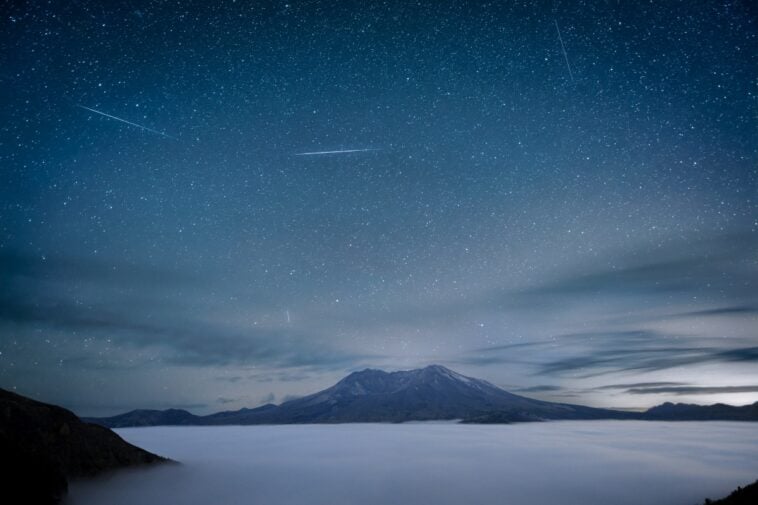
Two meteor showers will reach their peak this week, unfolding back-to-back between July 28 and 31.
The Southern Delta Aquariids shower will arrive first, reaching their strongest activity between July 28th and 30th, though they’ve been active since mid-July and will keep going until late August. At their maximum strength, they produce about fifteen meteors an hour, all of them appearing to radiate from the constellation Aquarius.
The meteors themselves are a result of debris left behind by comet 96P/Machholz, which orbits the Sun every 5.27 years.
What to expect and how to catch the show
The trouble with this particular shower is that the meteors tend to be faint, with thin trails that are easy to miss, and this year a bright moon, waxing gibbous on the 28th, full on the 29th, and still nearly full on the 30th and 31st, will be sitting in the sky washing out a good share of them.
That said, the Southern Delta Aquariids have beaten forecasts before, producing unexpected outbursts in both 1977 and 2003, so the final numbers remain unpredictable. Viewers in the Southern Hemisphere will get the better vantage, and in the north, the further south you happen to be, the more you’ll catch.
The Alpha Capricornids then take over on July 30 and 31. They originate from comet 169P/NEAT, which orbits the Sun every 4.2 years and radiates from the constellation Capricornus. Though they only manage to produce about five meteors an hour at peak, what they lack in volume they make up for in brightness, regularly throwing off fireballs that are far more visible than anything the Aquariids produce. This shower can be seen from both hemispheres.
It’s worth noting that neither meteor shower calls for equipment. Binoculars and telescopes narrow your field of view, which works against you when a meteor might appear anywhere overhead. Give your eyes about thirty minutes to adjust to the dark, then lie flat on your back and scan a wide swath of sky roughly halfway between the horizon and zenith, around 45 degrees off from Aquarius.
The only factor that could ruin the whole attempt is light pollution. Viewing is worth starting around 10 p.m., and both showers run through until dawn.
Sources: American Meteor Society, IMO, NASA, New York Post