
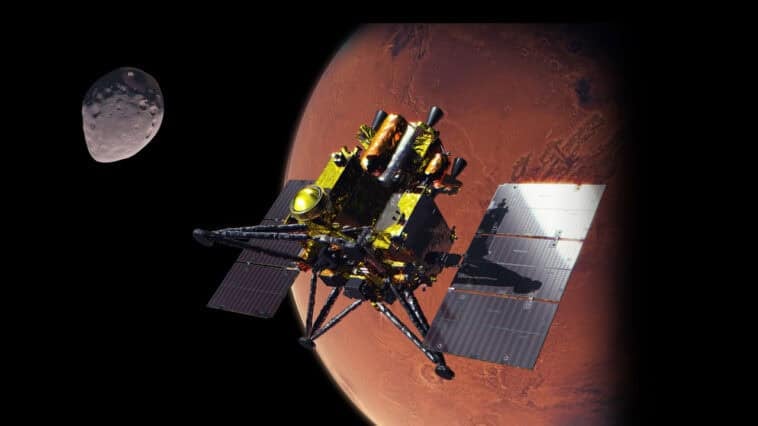
Japan could be on the verge of making space history by bringing home the first sample from the Martian system. While NASA continues working toward returning samples collected on Mars to Earth, Japan’s MMX mission is preparing to land on Phobos, one of Mars’ moons, collect more than 10 grams of surface material, and return it to Earth as early as 2031. The mission could reveal new clues about Mars and its mysterious moon while potentially putting Japan ahead in the race to deliver Martian material to scientists on Earth. But how exactly will the spacecraft pull off this ambitious mission, and could it really beat NASA home? Read on to find out.
A five-year journey to bring home a tiny sample
The journey begins at Japan’s Tanegashima Space Center, where JAXA’s Martian Moons eXploration (MMX) spacecraft is slated to launch aboard an H3 rocket. The mission establishes a tight, five-year timeline: MMX will reach Martian orbit in 2027, spend a full year mapping its target, scrape up surface samples, and fire a capsule back toward Earth.
If all goes to plan, a beach-ball-sized capsule will streak across the sky above the South Australian desert in 2031. Glowing like a meteor before deploying its parachute, it will gently deliver roughly a tablespoon of pristine alien soil to the Woomera testing range, marking humanity’s first direct sample from the Martian neighborhood.
Dancing with a gravity-defying moon
The target of this daring heist is Phobos, a lumpy, grey world spanning just 22 kilometers across. Resembling a potato more than Earth’s glowing satellite, Phobos orbits a mere 6,000 kilometers above Mars.
Because the moon is so small, its gravity is almost non-existent. On Phobos, Idefix — a 25-kilogram French and German rover hitching a ride on MMX — will weigh the equivalent of just 15 grams.
This microgravity presents a massive navigational challenge. MMX cannot simply fall into a traditional orbit, as Phobos lacks the gravitational pull to hold it. Instead, mission operators will maneuver the spacecraft into a “quasi-satellite orbit,” finely synchronizing its flight around Mars so it appears to shadow the tiny moon. When touchdown finally occurs, it will feel less like a landing and more like a slow, deliberate bump.
Two ways to scoop space dust
Because scientists have no idea whether the surface of Phobos consists of fine powder, jagged gravel, or hard rock, MMX comes equipped with a double-barreled sampling strategy:
- The C-Sampler: A robotic arm carrying a core drill designed to push a few centimeters into the ground and extract a solid core sample.
- The P-Sampler: A NASA-built pneumatic mechanism that shoots a burst of pressurized gas into the dirt, instantly blowing loose grains up a tube and into a collection vial.
Before MMX touches down, it will drop the Idefix rover from several meters up. Crawling across the terrain, Idefix will give controllers their first real-time look at how the surface responds to wheels. Across two planned landings, JAXA aims to collect over 10 grams of material. While that sounds modest, modern laboratory equipment can perform thousands of tests on a single milligram, leaving the rest preserved for future generations.
Solving a cosmic cold case
Why travel tens of millions of miles for a handful of dust? Because Phobos holds the key to a long-standing solar system mystery: Where did Mars’ moons actually come from?
Scientists are currently split between two competing theories:
- The Giant Impact: A massive collision hit early Mars, launching a ring of planetary debris that fused together to form moons.
- The Captured Asteroid: Phobos was an asteroid wandering through the outer solar system before being snagged by Mars’ gravitational trap.
While Phobos orbits smoothly along the Martian equator (suggesting an impact origin) its dark, reddish surface looks suspiciously like a stray asteroid.
Phobos could contain actual pieces of Mars
The scientific jackpot goes beyond the moon itself. Over billions of years, asteroid impacts on Mars have blasted planetary rock into space, showering Phobos in the process. Models suggest Martian dirt makes up hundreds of parts per million of the moon’s topsoil.
With NASA’s own Mars Sample Return program currently stalled by budget cuts, the tubes collected by the Perseverance rover remain parked on the Martian surface without a clear flight home. Consequently, the speck of dust JAXA scrapes off Phobos in 2031 may end up being the only piece of Mars to reach a terrestrial laboratory this decade — arriving as hitchhiking cargo on someone else’s moon.
Source:
Science Daily