
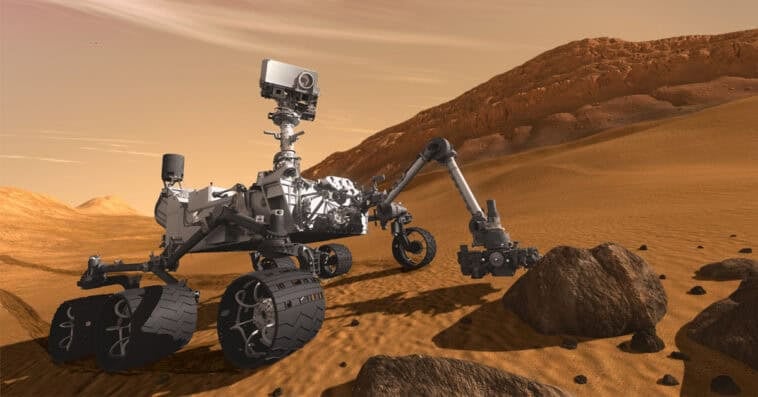
Mars may look barren today, but beneath its dusty surface, scientists are uncovering clues that tell a very different story. NASA’s Curiosity rover has discovered complex organic molecules in ancient Martian rocks, the same kinds of chemicals that help form life on Earth. While the discovery stops short of proving life once existed on Mars, it opens the door to a far more intriguing question: are these the lingering traces of a once-living world, or evidence that the Red Planet was always capable of supporting life?
Ancient Martian lakebed reveals chemicals tied to life’s origins
While exploring an ancient, dried-up lakebed near the planet’s equator, NASA’s Curiosity rover detected several organic molecules, specifically carbon-based chemicals commonly associated with life on Earth. According to a new study published in the journal Nature Communications, five of the seven compounds identified had never been seen on Mars before, making the discovery even more significant. While Curiosity’s onboard lab can’t yet confirm if these molecules came from ancient alien microbes, meteorites, or natural volcanic activity, the discovery proves one vital thing: the evidence of potential life we’re looking for is still there.
A 3.5-billion-year-old mystery
The findings suggest that if life ever existed on the Red Planet, its fingerprints have been preserved against all odds. This is a massive relief for scientists who feared that the planet’s brutal radiation would have erased all traces of history ages ago.
“We think we’re looking at organic matter that’s been preserved on Mars for 3.5bn years,” said Amy Williams, an astrogeologist at the University of Florida who led the research. “Is it life? We can’t tell, based on this information.”
Why this matters
For decades, the scientific community worried that the window of time when Mars was most habitable (roughly 4 billion years ago) was too far back for any evidence to survive the test of time.
Williams notes that the discovery of these large, intact molecules changes everything: “For a long time, we thought that all organic matter was going to be seriously degraded by that harsh radiation environment. It’s really exciting to see [that] large complex material can survive in the subsurface environment.”
What exactly did Curiosity discover?
Since 2012, the car-sized Curiosity rover has been exploring the rugged terrain of Gale Crater and Mount Sharp. Recently, its onboard laboratory hit a major milestone, detecting a variety of carbon-rich compounds—the essential chemistry linked to the existence of life.
Among the discoveries was benzothiophene, a sulfur-based chemical frequently carried across the solar system by meteorites. Even more intriguing was the hint of a nitrogen-based organic compound with a structure strikingly similar to the precursors of DNA.
The ‘bricks’ of life
While these findings are thrilling, scientists are quick to point out that finding these chemicals isn’t the same as finding a fossil. These molecules act as the raw materials for biology, but they can also be created by non-living geological processes.
“There are several steps between what we found and DNA,” explains Prof Amy Williams. “It is definitely a building block to how DNA is made now. But it is truly just the bricks, not the house. You can generate these molecules geologically.”
The discovery also highlights a deep connection between Mars and our own home. During the early days of the solar system, both planets were bombarded by the same space debris, which may have “seeded” the worlds with the potential for life.
“The same stuff that rained down on Mars from meteorites is what rained down on Earth, and it probably provided the building blocks for life as we know it on our planet,” Williams added.
What’s next for Mars
The latest findings from Curiosity are just the beginning, serving as a vital roadmap for the next generation of space exploration. All eyes are now on the European Space Agency’s Rosalind Franklin mission, which is currently slated for a 2028 launch.
While Curiosity has scratched the surface, the Rosalind Franklin rover is designed to go much deeper—literally. It will be equipped with a specialized drill capable of reaching two meters (about 6.5 feet) into the Martian ground. This is a game-changer because the deeper soil has been shielded from the sun’s destructive radiation for eons, potentially housing even better-preserved evidence.
With more advanced testing tools on board, scientists hope to finally determine if these Martian chemicals are:
- Biological: Leftovers from ancient alien life.
- Geological: The result of the planet’s own natural chemistry.
- Cosmic: Delivered by ancient meteorites.
By digging beneath the surface, the Rosalind Franklin mission aims to solve the mystery Curiosity has uncovered, potentially providing the definitive proof that Mars was once a living world.
Sources: The Guardian, Nature Communications