
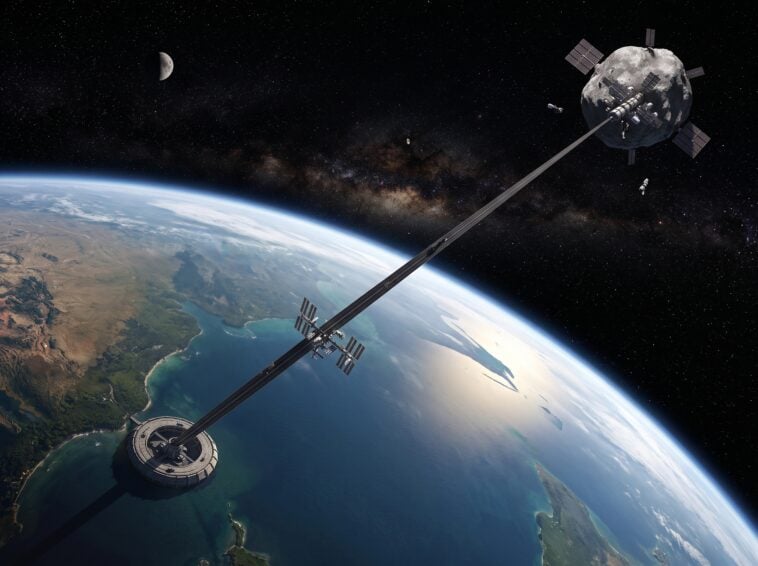
Forget rockets. Scientists are working on a giant elevator that could carry people and cargo into space.
The idea has been around for more than a century, but there’s always been one enormous problem. What do you build a 62,000-mile-long cable out of without it snapping under its own weight? Researchers now think they may have a serious contender.
Meet the material that could make a space elevator possible
The International Space Elevator Consortium (ISEC) is preparing to announce polycrystalline graphene as its most promising tether material yet. Graphene is essentially a one-atom-thick sheet of carbon atoms. It is famously strong and lightweight, which is exactly what you’d want for a cable stretching from Earth into space.
The “polycrystalline” part is important, too. Instead of relying on one enormous crystal that’s nearly impossible to manufacture, the material uses a patchwork-like structure designed to make graphene more scalable.
Researchers are already making surprisingly large pieces of this material. Engineers in South Korea have reportedly produced a 1,000-meter-long, half-meter-wide piece of polycrystalline graphene at a rate of around two meters per minute. That’s still nowhere near 100,000 kilometers. But hey, every mega-project has to start somewhere.
The concept of a space elevator
Picture an enormous cable attached to an “Earthport” near the equator. Instead of stopping at the edge of space, the tether would continue beyond geostationary orbit to a counterweight in space.
Earth’s rotation would keep the entire structure stretched tight. Then you’d simply take an elevator up. Cargo vessels called climbers would electrically crawl up the tether, eventually reaching geostationary orbit roughly 22,000 miles above Earth.
Beyond that point, Earth’s rotation provides enough centrifugal force to propel the climber outward. According to ISEC’s calculations, cargo could eventually be flung into space at around 16,000 mph.
Trips to the Moon could get dramatically shorter
A space elevator could fundamentally change how humans move around the solar system. ISEC estimates that cargo launched from the top of the tether could reach the Moon in roughly 14 hours, compared with around three days using current methods.
Mars could potentially become a 61-to-120-day trip, depending on where the planets are when you launch.
For comparison, the fastest conventional trip to Mars currently takes around seven months, and favorable launch windows only come around every 26 months. So, in the most optimistic version of this future, “We’re going to Mars” looks a little more like transportation than a once-in-a-generation space mission.
Building the thing is a problem
A space elevator is not something you assemble over a long weekend with an IKEA manual. The proposed tether would stretch roughly 62,000 miles, with individual molecular strands envisioned as just one atom thick but up to a meter wide.
And then there’s space junk. Thousands of objects are already orbiting Earth at terrifying speeds, and a collision with the tether could be catastrophic. ISEC has suggested using multiple tethers as backups and creating restricted zones around the elevator to reduce the risk.
Money could also be a limitation. ISEC has floated a cheeky $15 billion estimate for a fully robotic first space elevator. That might sound like a lot until you compare it with the cost of conventional space exploration. NASA’s Artemis program alone is expected to cost more than $200 billion through 2030.
Still very far from pressing ‘up’
Even supporters aren’t pretending the elevator is ready to open for business. Space economics professor Armen Papazian estimates that even if construction started tomorrow, it could take 10 to 20 years to complete, assuming the necessary financing exists and everything goes according to plan.
The economics presents another headache. Investors could potentially wait decades before seeing meaningful returns. The initial years would probably be focused almost entirely on hauling cargo into space. People would come later, once the infrastructure proved itself. But that’s still the dream.
Sources: New York Post, NDTV