
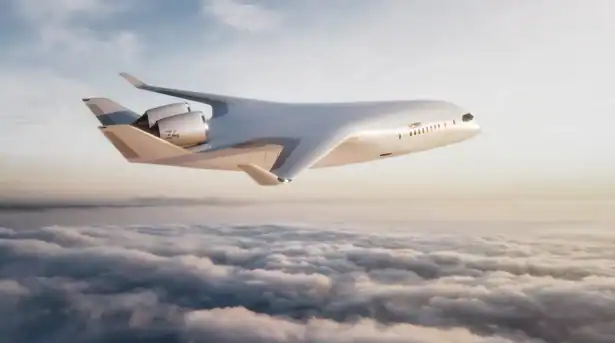
Unless it’s something straight out of a Sci-Fi movie, we can all agree that commercial airplanes have looked pretty much the same for decades. A tube with wings glued onto the sides.
Japan Airlines is hoping to shake things up by partnering with aerospace startup JetZero to help build the Z4, an aircraft that could reduce flight tickets drastically.
High-tech futuristic wings that make flying cheaper
The idea behind JetZero’s Z4 program is a futuristic 250-seat passenger plane shaped like a manta ray or stealth bomber that aims to hit the skies in the early 2030s.
At the Farnborough Air Show, Japan Airlines announced it is jumping into JetZero’s airline advisory group to help refine the aircraft’s cabin layout, flight operations, and ground handling.
Instead of dragging a heavy fuselage through the air, the Z4 uses a Blended Wing Body (BWB) design where the body and wings merge into one smooth, continuous surface. The BWB design helps the entire aircraft generate lift. Less drag, less thrust needed, less fuel burned.
Major fuel savings, long-range capability, and cheap flights
JetZero projects the Z4 will burn 30% to 50% less fuel than current passenger jets. The futuristic aircraft’s lower fuel consumption is good news for passengers as the fuel consumption rate means lower operating costs for airlines, which could then translate to lower ticket prices down the road.
The aircraft is also designed to fly up to 5,000 nautical miles (around 6,165 miles). It could even handle transpacific routes like Tokyo to the US West Coast effortlessly.
Fits existing airports and delivers a quieter cabin experience
Unlike super-sized planes like the Airbus A380 and heavy freighters like the Antonov An-225 that need custom infrastructure, the Z4 is designed to fit right into standard airport gates without needing costly modifications.
The aircraft’s design places the engines right on top of the rear fuselage, which uses the plane’s structure as a natural shield to block engine noise from hitting the ground and cabin. It’s also worth noting that one of the key drivers of Japan Airlines’ interest in the aircraft is the elevated passenger and crew experience it promises.
Big airlines are betting millions on the radical design
Big players like Japan Airlines are putting serious money behind Z4 even though it’s still about four years before we see it take to the skies.
“Collaborating with JetZero on the Z4 aligns perfectly with our commitment to sustainable innovation and net-zero emissions by 2050,” said Takao Suzuki, a top executive at Japan Airlines. “By integrating our operational expertise into the Z4’s development, we look forward to contributing to a new era of efficient air travel.”
JetZero has already collected backing from United Airlines, Alaska Airlines, RTX Ventures, and Northrop Grumman, while pulling in over $1 billion in total funding and commitments.
The company has also broken ground on a massive manufacturing plant in North Carolina to prepare for production.
A wild design that hasn’t taken flight just yet
While the concept is super exciting, there is a catch: the passenger jet doesn’t exist as a full-scale flying prototype yet. So if you plan to fly the Z4 on your next flight to Asia, that trip would have to be taken in or after 2030.
While JetZero has been test-flying a one-eighth scale model called Pathfinder out of Edwards Air Force Base since 2024, the full-scale demonstrator won’t fly until 2027. That version won’t even carry passengers.
Sources: AutoNotion, JetZero