
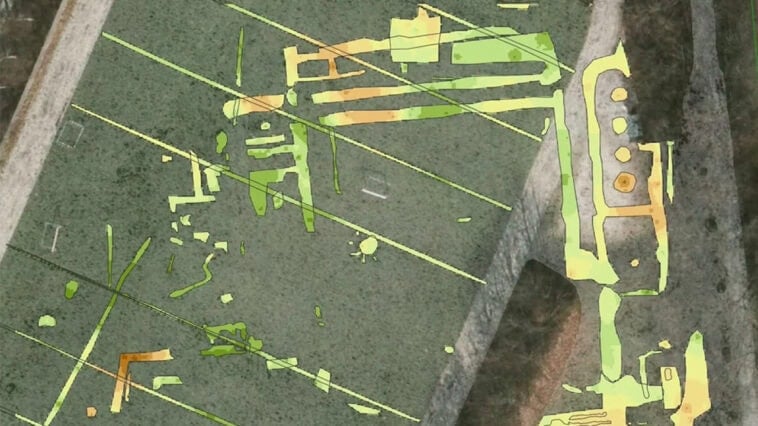
A soccer field in Denmark has turned out to be the unlikely hiding place of a medieval secret buried for centuries. Using ground-penetrating radar, archaeologists have uncovered the remarkably well-preserved remains of St. Clare’s Convent, a 13th-century complex that was long believed to have been destroyed. The scans have revealed traces of rooms, cloisters, pillars, and a church —but the most intriguing part may be what future excavations could reveal about the nuns who once lived there.
A routine survey uncovers a medieval surprise
What began as a standard environmental assessment for an underground parking garage ended up rewriting Danish history. Before construction could break ground, researchers conducted a non-invasive ground-penetrating radar survey over a sports field in Roskilde — a town rich in medieval heritage.
The scan results shocked the team from ROMU, a state-recognized Danish museum organization. Sitting barely three feet beneath the turf was the complete structural footprint of St. Clare’s Convent.
“The survey revealed a well-preserved convent complex approximately one meter [three feet] below ground level,” officials said in a press release detailing the find.
The imaging unveiled an expansive layout: cloistered walkways, individual rooms, and a church anchored in the southern wing. Archaeologists were particularly stunned by the condition of the eastern wing, describing it as “exceptionally well-preserved, with clearly defined rooms and vault pillars.”
Lost to history, found by radar
During the Middle Ages, Roskilde boasted five major monastic complexes that helped shape it into one of the region’s wealthiest trading hubs. While the other four sites were cataloged and legally protected as ancient monuments, St. Clare’s was omitted. Historians had long assumed that centuries of urban expansion and land redevelopment had erased the site.
That assumption changed overnight without shifting a single shovel of earth.
As Jesper Langkilde, an expert from ROMU, noted: “It is an excellent example of how much archaeological knowledge a geophysical survey can contribute — under the right circumstances — without even putting a shovel to the ground.”
Langkilde emphasized that the discovery “[is] very significant, since we know very little of the monasteries in Roskilde from an archaeological point of view,” adding that the find represents “a very big step forward for our knowledge of the medieval monasteries,” which “played a key part in the development of Roskilde as one of the most important and wealthiest towns in medieval Denmark.”
What the site could reveal about the nuns
Archaeologists could potentially uncover objects that shed light on everyday life inside the convent.
“The convents and monasteries were centers of literacy and had libraries and book production,” Langkilde said, adding that researchers could find book fittings, writing utensils and personal belongings such as combs and needles.
Organic remains could provide another valuable source of information. If those materials have survived underground, archaeologists may be able to learn more about what the nuns ate and which plants were cultivated in the convent’s gardens.
Burials could offer an even more personal glimpse into the community.
Researchers expect to find graves at the site, which “can tell us about who the nuns were and who else was buried at the convent,” Langkilde said.
Clues to an international connection
The convent could also reveal how closely medieval Roskilde was connected to other parts of Europe.
Langkilde said the first nuns at St. Clare’s are believed to have arrived from a convent in Strasbourg, suggesting that the community was connected to a wider network beyond Denmark.
“The convents were part of international networks, so it would be interesting to look for signs of international relations in the [material] from this site,” he said.
Any artifacts linked to other regions could help researchers understand how people, ideas and religious traditions moved across Europe during the medieval period.
The next chapter for Roskilde’s lost convent
As archaeologists look toward future physical excavations, the remarkable site beneath Roskilde’s sports turf stands as a powerful reminder of how much history remains hidden just beneath our feet. By bridging cutting-edge satellite imaging with traditional archaeology, the rediscovery of St. Clare’s Convent promises to transform our understanding of medieval monastic life, trade, and culture — turning a quiet local playing field into one of Scandinavia’s most exciting windows into the past.
Sources:
Fox News