
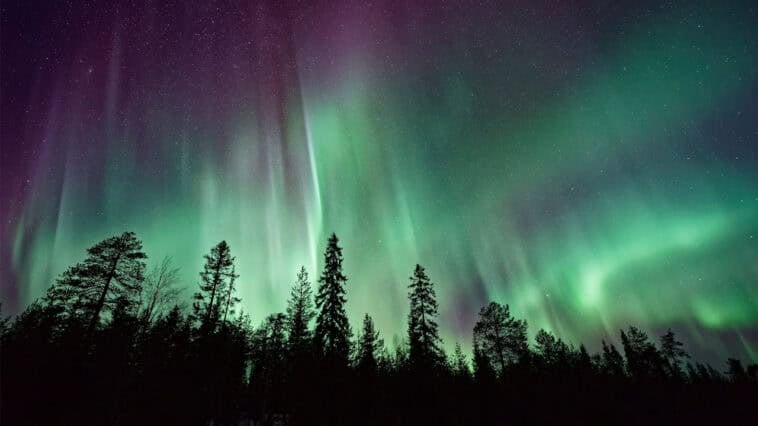
The night sky could be putting on a spectacular show across parts of the U.S. as the Northern Lights return for another chance to dazzle stargazers. Forecasters say several northern states could have an opportunity to see the aurora borealis on September 9 and 10, but where you are — and when you look — could make all the difference. With dark skies and favorable conditions potentially giving some Americans a front-row seat, which states have the best chance of seeing the lights, and what time should you head outside?
Which states have the best chance of seeing the northern lights?
For Americans hoping to catch a glimpse of the aurora borealis, the best opportunities are expected across the northern tier of the country. If skies remain clear, Alaska, Washington, Idaho, Montana, North Dakota, South Dakota, Minnesota and Wisconsin could all have a chance to see the colorful display.
The National Oceanic and Atmospheric Administration’s (NOAA) Space Weather Prediction Center says the potential viewing window stretches from about 6 p.m. to 6 a.m. U.S. Central Time. However, the odds are not the same everywhere. Northern Alaska has the strongest chance of seeing the aurora, while areas farther south and along the U.S.-Canada border could have a lower probability.
Canada is also expected to be well positioned, with much of the country facing favorable conditions for viewing the lights.
What causes the northern lights?
The aurora borealis is created by a spectacular interaction between the sun and Earth’s magnetic field.
Charged particles released by the sun travel toward Earth and interact with magnetic field lines near the planet’s polar regions. When those particles collide with gases such as oxygen and nitrogen in the upper atmosphere, they release energy in the form of glowing, moving bands of light.
The result can be a shifting display of green, red, purple or other colors across the night sky.
Because the aurora cannot be seen during daylight, the most favorable opportunities generally come after sunset and before sunrise. When the display becomes bright enough and visibility is good, the lights can sometimes be seen from roughly 62 miles away.
Why September can be a good month for aurora viewing
There is another reason skywatchers may want to pay attention this month. September is considered a favorable period for Northern Lights activity because of the equinox.
Scientists refer to the phenomenon as the Russell-McPherron effect, which describes how geomagnetic activity can increase around the equinoxes. During these periods, Earth’s magnetic field can become more favorably aligned with the solar wind, increasing the potential for auroras.
This means September can offer some particularly promising opportunities for people living in northern parts of the U.S.
Dark skies could make the display easier to spot
Even if the aurora is active, light pollution can make it difficult to see. Anyone hoping to watch the show should consider heading away from brightly lit cities and finding a location with a clear view of the northern horizon.
A light-pollution map or dark-sky finder can help identify better viewing locations. The darker the surroundings, the easier it may be to notice faint auroral activity.
This week’s new moon could provide another advantage. With little or no moonlight competing with the aurora, darker skies may improve viewing conditions, particularly if the display is relatively faint.
Check the forecast before heading outside
One of the challenges of watching the Northern Lights is that the phenomenon can be unpredictable. Auroras often appear in waves, meaning conditions can change significantly over the course of an evening.
For that reason, checking an updated forecast before and during a viewing attempt can be worthwhile. NOAA provides a short-term aurora forecast, along with information on activity during the previous 24 hours, through its Aurora – 30 Minute Forecast.
A strong forecast does not guarantee that the lights will be visible from a particular backyard, but it can help skywatchers determine when their chances may be highest.
Solar activity can give auroras an extra boost
The Northern Lights are ultimately driven by activity on the sun, and recent solar events have already produced impressive displays across parts of the northern U.S.
Earlier this year, a large opening known as a coronal hole appeared in the sun’s outer atmosphere. These regions occur where the Sun’s magnetic field opens outward, allowing streams of solar wind to escape into space at unusually high speeds.
These fast-moving streams, known as High-Speed Streams (HSS), can eventually reach Earth. When they interact with our planet’s magnetic environment, they can increase geomagnetic activity and potentially strengthen auroras.
That solar connection is also why aurora forecasts can change quickly. What begins as a quiet night can sometimes turn into a much more impressive display if solar activity increases.
Want to photograph the northern lights? Try these phone settings
Seeing the aurora is one thing; capturing it on a smartphone is another. Modern phones can photograph much more of the night sky than the human eye can easily detect, but choosing the right settings can make a noticeable difference.
For iPhone users, Night Mode can help capture more light in dark conditions. Those with more advanced controls can also experiment with Pro Mode settings.
The main camera lens is generally a better choice than the ultra-wide lens because it can collect more light. If the phone supports RAW photography, shooting in RAW can also be useful for anyone planning to edit the image afterward.
Above all, a steady phone and a dark location can make the biggest difference. With the right combination of solar activity, clear skies and minimal light pollution, skywatchers in the favored states could have a chance to see one of nature’s most spectacular nighttime displays.
Source:
New York Post