
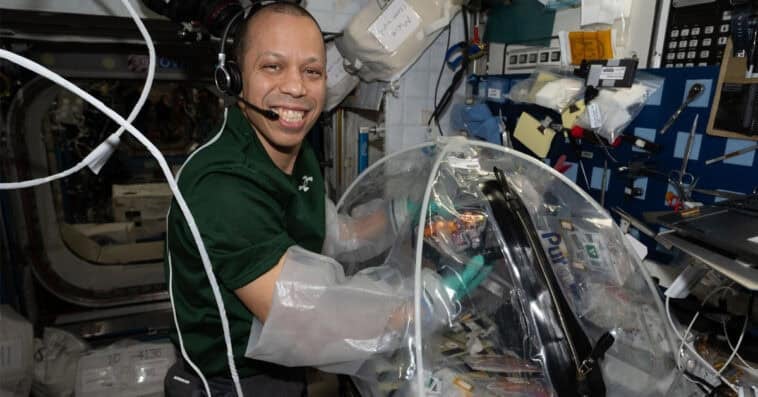
NASA is taking cancer research beyond Earth — and into orbit. Right now, aboard the International Space Station (ISS), scientists are studying how cancer medicine behaves in zero gravity to see if space can reveal clues that are impossible to observe on the ground. It might sound unusual, but researchers believe the weightless environment of space could reveal hidden vulnerabilities in cancer cells that are impossible to detect on the ground, potentially changing how we treat the disease forever.
New cancer study begins aboard the International Space Station
Floating high above our planet, the Expedition 74 crew is currently searching for new ways to defeat one of Earth’s deadliest diseases. On May 19, NASA flight engineer Chris Williams set up a brand-new experiment called Space Cancer Therapeutics inside the station’s Kibo laboratory module. Just recently delivered by a SpaceX Dragon cargo ship, this groundbreaking study uses the weightless environment of space to look at an anti-cancer drug in a whole new light. Without the pulling force of gravity, scientists can see exactly how the drug attacks cancer cells at a microscopic level.
Working right alongside Williams, European Space Agency (ESA) astronaut Sophie Adenot added a vital piece of equipment, a specialized humidifier, to the station’s biology research facility. This upgrade keeps the environment perfectly stable for the living cells and cancer samples being used in the study, ensuring the delicate experiment runs smoothly.
The hope is that this orbital research will unlock secrets to creating much more powerful treatments for pancreatic cancer, benefiting patients back home on Earth.
Other health research happening in orbit
Alongside the cancer study, the crew aboard the ISS is also carrying out several other health research. NASA flight engineer Jessica Meir is working on growing cartilage tissue in space using specialized equipment designed to help the cells form more natural structures. She carefully processed and preserved cartilage samples that were grown on Earth and delivered to the station aboard SpaceX Dragon, using the Kibo laboratory module’s Life Science Glovebox. These samples will then be incubated in the Space Automated Bioproduct Laboratory, where researchers hope to better understand how weightlessness can improve cartilage tissue engineering. The results could one day help develop improved ways to protect astronauts’ physical health and even lead to better implants for patients on Earth with joint injuries.
Meanwhile, NASA flight engineer Jack Hathaway spent his May 19 shift supporting a range of biotechnology and life science studies. He began by swapping hardware inside the Advanced Space Experiment Processor-2, helping enable research into the production of pharmaceutical compounds. He then serviced a centrifuge in the Columbus laboratory module’s Human Research Facility, ensuring ongoing experiments continue to run smoothly.
Preparing for a spacewalk outside the ISS
The Expedition 74 crew is also preparing for an upcoming spacewalk scheduled for later this month outside the International Space Station. Roscosmos cosmonauts Sergey Kud-Sverchkov and Sergey Mikaev began by carefully inspecting a pair of Orlan spacesuits to make sure all life support and communication systems were properly installed and working as expected. They then reviewed the detailed procedures for the planned spacewalk, which will take place at a date and time still to be confirmed by NASA.
Later on, they were joined by fellow Roscosmos flight engineer Andrey Fedyaev to go over the full set of spacewalking tasks planned for the excursion. The preparation work is part of the crew’s ongoing efforts to ensure every step is carefully rehearsed before venturing outside the orbiting laboratory.
Source: NASA