
A shipwreck resting off the coast of Turkey for nearly 4,700 years may hold remarkable clues about how ancient civilizations traded goods across the Mediterranean. Archaeologists have uncovered ceramic jars and stone anchors from the vessel, which may have sailed the seas around the same time the Great Pyramid of Giza was being built. What were these ancient sailors carrying, and how could their journey reshape what we know about early international trade? Keep reading to discover what researchers have uncovered from the world’s oldest known seagoing shipwreck.
Shipwreck offers a rare glimpse into Bronze Age trade
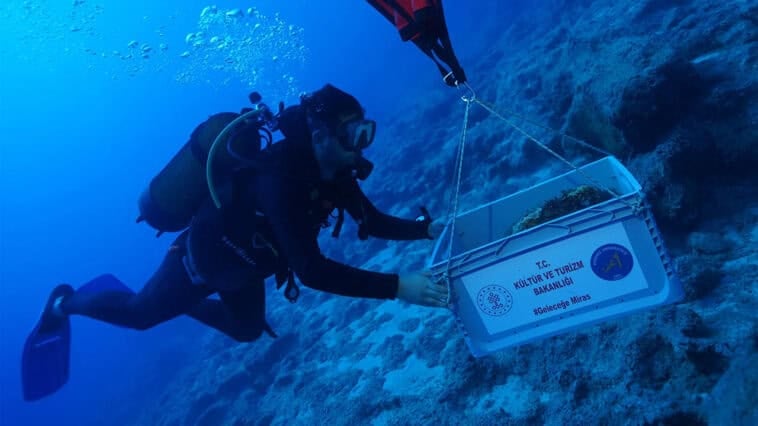
Archaeologists believe a ship discovered off Turkey’s southern coast could be the oldest known remains of a seagoing vessel. The wreck, found near Kekova Island in Antalya, is estimated to be between 4,400 and 4,700 years old, placing it in the Early Bronze Age, according to the BBC.
The discovery was documented in research published in the Journal of Maritime Archaeology. Although the wooden hull has disintegrated over thousands of years, researchers recovered more than 30 ceramic jars known as amphorae, along with three large stone anchors. An amphora is a two-handled container commonly used to transport and store goods in ancient times.
The team estimates that the vessel measured approximately 33 feet long and carried commercial goods across the Mediterranean Sea.
Discovery reveals connections between ancient civilizations
The shipwreck could help researchers better understand how early societies exchanged goods over long distances. Professor Hakan Öniz of Akdeniz University in Turkey, who led the expedition, said the artifacts’ “decoration techniques” confirmed that the wreck was “100%” from the “Early Bronze Age.”
Dr. Karin Sowada, an archaeologist at Australia’s Macquarie University who worked on the project, described the vessel as a “missing piece” in the history of ancient commerce in the eastern Mediterranean.
“It was [traveling] along the southern coast of Turkey with trade goods that we now know belonged to a much wider exchange network,” she added in an interview with People. “For example, Egypt was importing silver from Greece via Byblos in Lebanon at this time. Ships like this were possible intermediaries in that trade.”
Öniz told People, “This discovery sheds light on both early maritime trade and the early international commercial and political relationships established between civilizations. It has pushed back the timeline of what we know about these subjects by about a 1000 years.”
He added, “Just imagine — we are talking about 5000 thousand years ago. People were farming at the western edge of Mesopotamia, producing wine from grapes and olive oil from olives, and selling these products thousands of miles away from their own farmlands.”
Researchers believe the vessel may have been carrying its cargo toward the ancient city of Troy or the Minoan civilization on Crete.
Mysterious residue survives thousands of years underwater
One of the most intriguing aspects of the discovery is what remains inside some of the ceramic jars. Found approximately 98 feet below the surface, the artifacts contained hardened black residue that has surprised researchers.
The substance’s identity has yet to be established. Sowada suggested several possibilities: “It could be olive oil, it could be wine, it could be tree resins.”
She also told the BBC, “Such long-term preservation in water-logged conditions was surprising, and on reflection says something about the nature of the contents, which I hope will be answered by future scientific analyses.”
The residue might also reflect how ancient merchants reused their containers rather than discarding them after a single journey.
Artifacts will go on public display in Turkey
Beyond the cargo, the team identified a churning amphora that may have been used to process milk during long voyages.
Öniz told PEOPLE, “Actually, we found traces of these substances, not the liquid itself. Analyses regarding this are ongoing. But most importantly, we found a churning amphora likely used by the sailors on board. They probably kept goats on the ship, utilizing their milk — rather than just their meat — during long voyages. They were producing their own butter and cheese right there on the ship.”
For Öniz, the discovery represents the culmination of years of underwater research.
“It is a matter of hard work. Before reaching this shipwreck, we had discovered and documented 433 other shipwrecks. But this is the oldest one. It is a magnificent feeling.”
The wreckage is now under the ownership of Turkey’s Ministry of Culture. The recovered artifacts are expected to be displayed at the new Mediterranean Underwater Archaeology Museum in Antalya, which is scheduled to open in the coming months, according to the BBC.
Before this discovery, the oldest known shipwreck was found near Greece’s Dokos island and dated to approximately 4,200 years ago. A separate wreck discovered in the Black Sea off Bulgaria, meanwhile, is believed to be the oldest known shipwreck with its structure still intact, dating back around 2,400 years.