
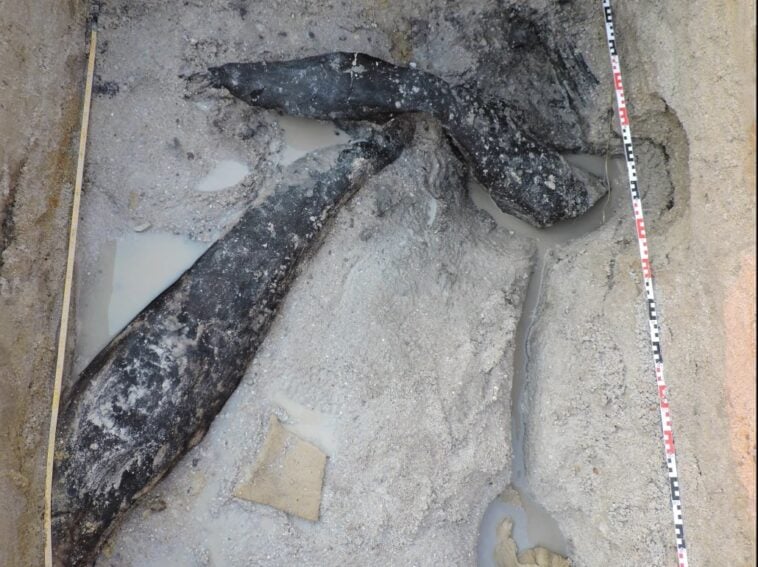
Nearly half a million years ago, long before Homo sapiens walked the Earth, early hominins on a riverbank in Zambia did something scientists thought impossible for their time: they built a structure from wood.
Dating back roughly 476,000 years, deep within the Early Stone Age, the find stands as the oldest known wooden structure in the world: two logs deliberately shaped and fitted together by early human ancestors.
The discovery, made in waterlogged sand along the Kalambo River and published in Nature in 2023 by a team led by Larry Barham of the University of Liverpool alongside researchers from Aberystwyth University, remains one of the most consequential archaeological finds of recent years.
The structure consists of an upper log, a piece of bushwillow, which rests across a second larger trunk. A notch was cut into it so the two would fit together. Marks on the wood show it was shaped with stone tools.
“Forget the label ‘Stone Age,’ look at what these people were doing: they made something new, and large, from wood,” Barham said in a joint statement at the time of the publication of the team’s paper in Nature.
Alongside the logs, archaeologists also recovered smaller wooden implements from nearby layers, including a pointed digging stick and a wooden wedge used for splitting timber.
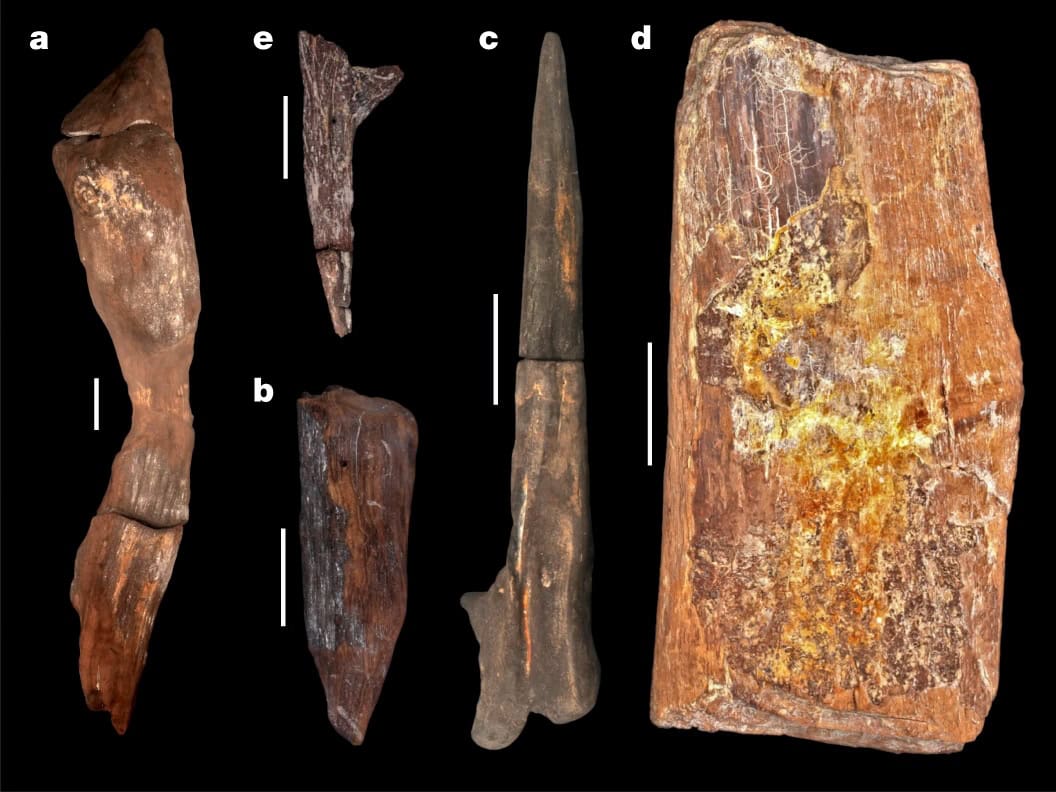
Researchers from Aberystwyth University dated the logs using luminescence dating on the sand they were buried in. The wet conditions at the site kept the wood from rotting. Wood had also been recovered at Kalambo in the 1960s, but it couldn’t be dated at the time.
“Our research proves that this site is much older than previously thought, so its archaeological significance is now even greater,” said Geoff Duller of Aberystwyth University.
Before this discovery, the oldest known joined wooden structure was about 9,000 years old.
Since no human remains were found at the site, it’s not known who built it. Barham, however, believes the architects of the structure may have been Homo heidelbergensis, a large-brained ancestor to modern humans and Neanderthals, known in the region from the famous ‘Broken Hill’ (Kabwe) skull discovered in central Zambia.
Researchers also cannot rule out Homo erectus, the remarkably long-surviving ancestor credited with inventing the advanced stone cutting tools used to shape the timbers.
The team thinks the logs may have been part of a raised platform or walkway on a riverbank that often flooded. “They transformed their surroundings to make life easier, even if it was only by making a platform to sit on by the river to do their daily chores,” Barham noted.
Since their excavation, the fragile logs have undergone years of specialized freeze-drying at the York Archaeological Trust in the U.K. to prevent the ancient wood from crumbling. Now prepared for their return to Zambia’s Livingstone Museum, the timbers have also been preserved through ultra-high-resolution 3D digital scans, ensuring future generations of researchers worldwide can study the prehistoric carpentry without risking damage to the original wood.
Sources: Nature, University of Liverpool, Latination