
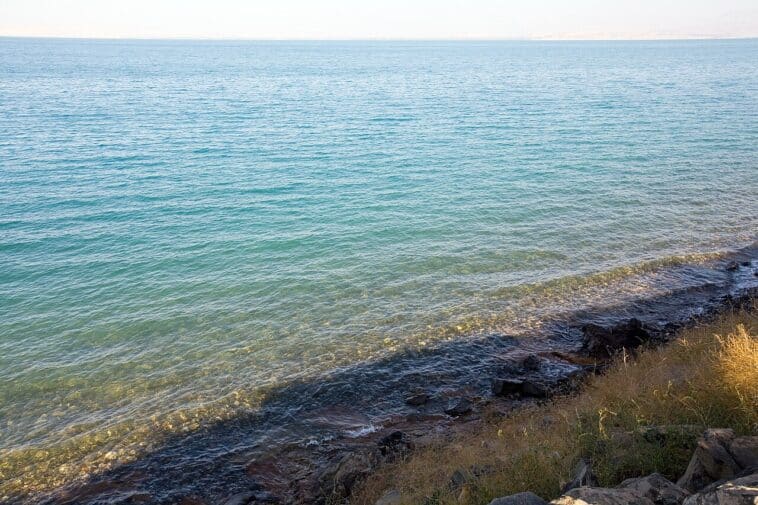
Divers exploring Lake Van in eastern Turkey have filmed a stone wall 75 feet below the surface, and one member of the team believes it could be the edge of a city older than recorded history.
The wall rises in seven courses of fitted stone to more than eight feet, with three steps climbing toward a large circular structure on the lakebed. Independent researcher Matthew LaCroix said it runs well past what the team has been able to see.
LaCroix took the find public on his own show, The Lost Civilizations Podcast, in an episode released this month titled I Found the Lost Ararat Civilization at the Bottom of Lake Van. Presenting previously unseen images of a circular megalithic structure and a causeway on the lakebed, he argued the ruins are far older than mainstream archaeology allows: “We see the footprint. We just don’t find their city,” he noted on the episode.
Speaking to the Daily Mail, LaCroix said, “What we know of the underwater ruins may just be a tiny piece of something much larger.” He says he measured more than 150 feet of the causeway, which continues into the darkness beyond.
No one noticed the wall while in the water, however. It appeared months later in footage shot by videographer Brandon Barnes behind the circular ruin.
Uncovering the depths
The lake first drew attention in 2017, when Turkish underwater filmmaker Tahsin Ceylan came across what looked like a stone fortress while studying the lake’s fish. LaCroix has since identified nearby circular temples and a capstone he says is carved with a six-spoked “Flower of Life,” a motif that recurs in several ancient cultures, though the name is modern. Ceylan later dove into the site with LaCroix in 2025.
How old the ruins are is the central dispute. Lake Van once drained to the west until eruptions from Mount Nemrut blocked that outlet during the Pleistocene, an epoch that ended 11,700 years ago. Geologists generally date the lava flow that sealed the basin to the middle Pleistocene, roughly 250,000 years ago; LaCroix points instead to estimates as recent as 40,000 years. He argues the structures had to be standing before the water covered them.
Many archaeologists see a much younger site. Some attribute the walls to the Urartian kingdom, which controlled the region about 3,000 years ago, while others suspect medieval construction that reused older blocks. No stone from the lake has been independently dated, however, and no excavation has established that the structures belong to a city.
LaCroix’s timeline comes from the lake’s geology, not from the masonry itself. He remains convinced the wall was part of something larger and says it cannot simply go to nothing. There would have to be a major urban area it led to, in his view.
Answering that will take more work than a few dives. Because Lake Van has no outlet, fine sediment stays suspended in the water, and LaCroix says visibility holds only from roughly 5 a.m. to 11 a.m. His own time on the bottom amounted to eight minutes at the circular ruin, about 30 feet down.
Sonar mapping and study by underwater archaeologists would be needed to settle whether the causeway is man-made and where it goes. The lake sits about 90 miles from Mount Ararat, the mountain some believe is the resting place of Noah’s Ark.
Sources: Lost Civilizations Podcast, National Geographic, Anadolu, ScienceDirect, Daily Mail