
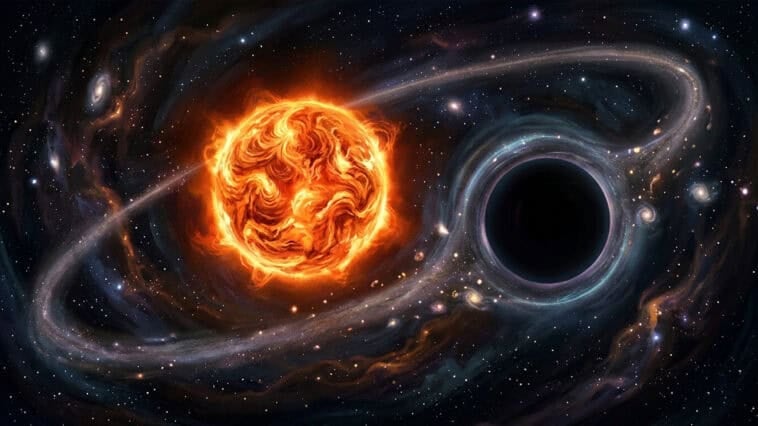
Space continues to keep its best secrets hidden in plain sight, and astronomers have just stumbled upon one of its most baffling mysteries yet. Deep in a distant star system, researchers have detected a completely invisible object whose unusual mass and wide orbit have challenged thousands of computer simulations, making it difficult to fit into existing models of how stars live and die. Whether it turns out to be an extremely rare neutron star or something entirely unprecedented, one thing is for sure: this ghostly cosmic anomaly is forcing scientists to rethink what they know about the universe.
Astronomers believe the mysterious object lurking in the J0008+0128 star system could be an extremely rare supermassive neutron star. These objects are the collapsed cores left behind when massive stars explode in supernovas. Researchers detected the invisible object by observing its gravitational influence on a nearby red giant star, rather than seeing it directly.
According to a study published in Science Advances, the object could have a mass up to 2.8 times greater than the Sun. This potentially places it within a mysterious region known as the “mass gap,” where relatively few stellar remnants have been observed.
Stellar remnants are the dense objects left behind after stars die. Depending on their original size, massive stars typically become either neutron stars or black holes. However, astronomers have long struggled to explain why so few objects fall between 2.5 and five times the mass of the Sun.
The newly discovered object could help scientists investigate this puzzling gap.
“We search for compact objects (mainly neutron stars and black holes) using large spectroscopic surveys,” said Song Wang, an associate researcher at the National Astronomical Observatories, Chinese Academy of Sciences, who co-authored the study, in an email to 404 Media. “We have found more than 10 neutron stars, and J0008+0128 is the most massive one among them.”
Why this invisible object is so unusual
The object’s enormous mass is not the only thing attracting scientific attention. It also follows an unusually wide orbit around its red giant companion, taking approximately 1,218 days to complete one revolution.
Under normal circumstances, stars more than 25 times as massive as the Sun are expected to collapse into black holes after exploding. Those roughly 10 to 25 times the Sun’s mass generally become neutron stars, while smaller stars like our Sun eventually turn into white dwarfs.
Neutron stars are incredibly dense, typically measuring only a few miles across. They contain matter packed so tightly that atoms are crushed, leaving neutrons primarily alongside protons and electrons. White dwarfs, by comparison, are much larger and roughly the size of Earth.
An unusually massive neutron star could help researchers understand how matter behaves under these extreme conditions.
One important mystery involves the neutron star’s “equation of state,” which describes how its internal pressure and density are related. Understanding this relationship could reveal how much mass a neutron star can accumulate before gravity forces it to collapse into a black hole.
“The equation of state of neutron stars is a long-standing unsolved problem in astrophysics, and neutron star masses can provide crucial observational tests,” Wang explained. “This is particularly true for massive neutron stars: how massive a neutron star can become depends on how ‘stiff’ its internal matter is in resisting gravitational collapse.”
“The discovery and measurement of supermassive neutron stars (i.e., those above two solar masses) can place important constraints on the equation of state of matter at extreme densities, helping to identify the theories that truly describe the behavior of matter under such extreme conditions,” he added.
Thousands of simulations fail to explain the discovery
Despite its potential scientific importance, J0008+0128 presents another major puzzle. The researchers ran thousands of computer simulations in an attempt to recreate the system’s unusual characteristics, but none successfully matched its physical properties and orbital behavior.
The unusually large distance between the suspected neutron star and its red giant companion is particularly difficult to explain. Neutron stars can grow more massive by pulling material away from nearby companion stars through gravity. However, the separation in this system makes that explanation unlikely.
“In fact, many compact objects discovered in recent years cannot be explained by standard binary evolution models and supernova mechanisms,” Wang noted, citing two other examples known as Gaia BH2 and G3425.
The researchers proposed several possible explanations. One possibility is that some supernova explosions can occasionally produce neutron stars massive enough to enter the mass gap.
Another theory suggests that J0008+0128 originally contained three stars. Two of them may have eventually merged, creating the unusually massive neutron star observed today.
“There may be two massive stars forming an inner binary,” Wang explained. “They can merge at different stages. For example, a neutron star merges with a normal star, or two neutron stars merge. Either case could produce the supermassive neutron star that we observe today.”
“In addition, if J0008+0128 formed through single-star evolution, its discovery would suggest that supernovae can produce massive neutron stars,” he added.
Future observations could reveal more clues
Understanding unusual systems like J0008+0128 could help astronomers improve existing theories about how massive stars evolve and eventually die. These discoveries could also provide valuable information about neutron star mergers, which produce gravitational waves. These are tiny ripples in space and time that scientists can detect using specialized observatories.
The research team identified the mysterious object with help from advanced astronomical surveys, including data collected by Europe’s Gaia space telescope. The observatory measures the positions and movements of stars with extraordinary precision, allowing researchers to identify objects that might otherwise remain hidden.
An upcoming Gaia data release, expected next month at the time of the study, could help narrow down the object’s estimated mass and provide additional clues about its origins.
“The discovery of J0008+0128, together with other systems discovered in these years (e.g., Gaia BH2 and G3425), suggests that much work remains to be done on binary evolution and supernova explosion theory,” Wang concluded.
For now, the invisible object remains an astronomical mystery. However, studying it could eventually help scientists understand some of the most extreme objects in the universe and where the boundary between neutron stars and black holes truly lies.
Source:
404 Media
Science Advances