
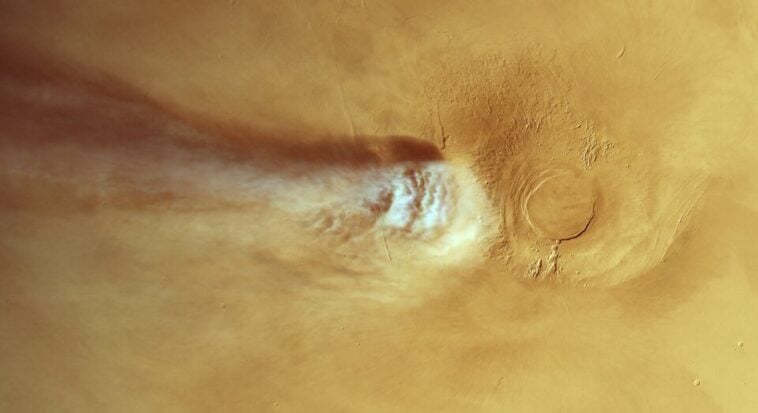
Space enthusiasts and astronomers have been tracking one of the Red Planet’s most fascinating atmospheric mysteries for years: a colossal plume officially known as the Arsia Mons Elongated Cloud (AMEC).
AMEC was first discovered in 2018 and quickly became one of the most elusive answers for scientists. Researchers have now resolved this mystery using the European Space Agency‘s Mars Express, in combination with a state-of-the-art meteorological model of the Red Planet. And what they found is that there may be some very exotic physics behind AMEC.
What is AMEC?
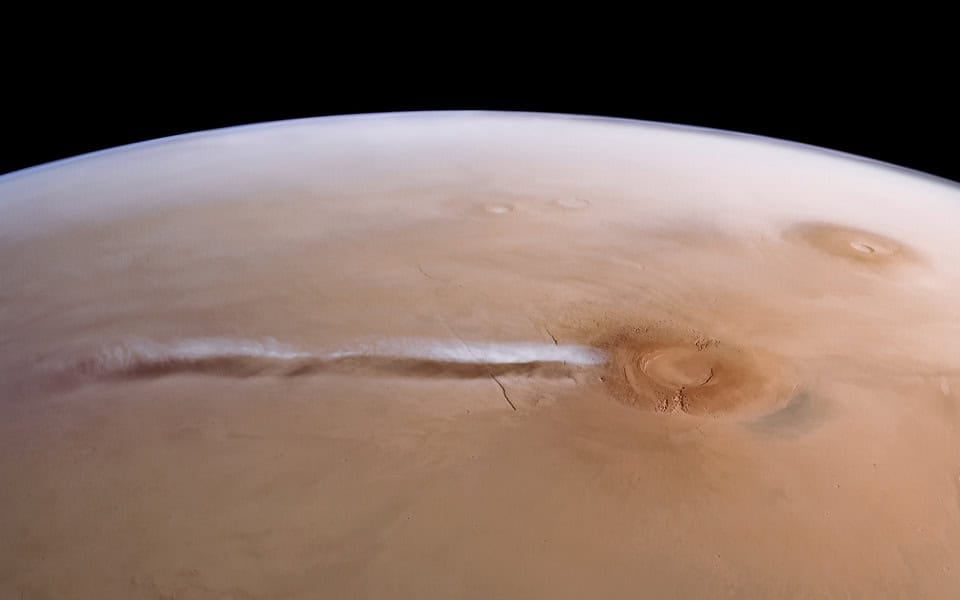
AMEC, which astronomers say is Mars’ most visually striking cloud, emerges every spring and summer in the Red Planet’s southern hemisphere during the dusty season. This massive white wisp of water ice forms downwind of the towering 20-kilometer-high Arsia Mons volcano.
The cloud runs through a daily routine, forming, growing and fading while stretching out an astonishing 1,800 kilometers. Simply put, that is nearly twice the length of the United Kingdom. The rising cloud then quickly evaporates into thin air as the morning progresses.
Cracking the cosmic code
Ever since the European Space Agency’s Mars Express orbiter first revealed the cloud in 2018, researchers have worked tirelessly to observe its evolution, vivid dynamics and behavior. However, when trying to model exactly how the cloud springs to life, standard computer simulations consistently failed to replicate how such a massive weather anomaly could form so rapidly out of thin air. That is, until scientists started factoring in some genuinely exotic physics—theoretical concepts found in textbooks that are usually thought not to happen in nature and certainly haven’t been seen in action before.
“To create the AMEC in our modelling, we found that we needed to include some exotic physics… physics that, while included in textbooks, is treated as theoretical and usually thought not to happen in nature. It certainly hasn’t been seen in action before,” says Jorge Hernández-Bernal, lead author of the new study. “Once we included this physics in our simulations, the AMEC emerged just as we hoped.”
Typically, clouds on both Earth and Mars form through a process called heterogeneous nucleation. This means that water vapor requires tiny microscopic specks like dust, salt or pollen floating in the atmosphere to cling onto before it can condense into liquid droplets or ice crystals. In Mars’ case, scientists initially believed it was dust. However, researchers have now found that to be wrong.
“For the AMEC, it seems that cloud formation takes place without needing any of this ‘stuff’,” said Hernández-Bernal.
Homogeneous nucleation in action
For this giant Martian cloud, however, simulations showed that water vapor turns directly into ice particles without needing any dust or foreign particles at all. This rare phenomenon is known as homogeneous nucleation, a process that researchers note has never been seen before in a planetary atmosphere.
Hernández-Bernal and his team found that this process requires extreme conditions where relative humidity levels rise to over 100,000 times higher than typical daily life on Earth. The unique geography of the Red Planet makes this happen through the following steps:
- As winds rush past the massive Arsia Mons volcano, the volcano’s bulk triggers a powerful wave.
- This wave lifts moist parcels of air several kilometers upward in just a matter of minutes.
- Temperatures then plunge rapidly by up to 30 degrees in only 10 minutes.
- This causes water vapor to spontaneously freeze directly into ice crystals.
A win for the unusual suspect
While solving this great mystery is one of the coolest things to happen to planetary study, the process in which the result was achieved proves thinking out of the box can really make the difference sometimes. The result of this research is a huge testament to why the unlikely angle of approach might be the only angle that works. Nothing and no one sums this up better than ESA Mars Express Project Scientist Colin Wilson who insisted that “exotic physics” such as this may be needed to solve other planetary mysteries in the cosmos.