
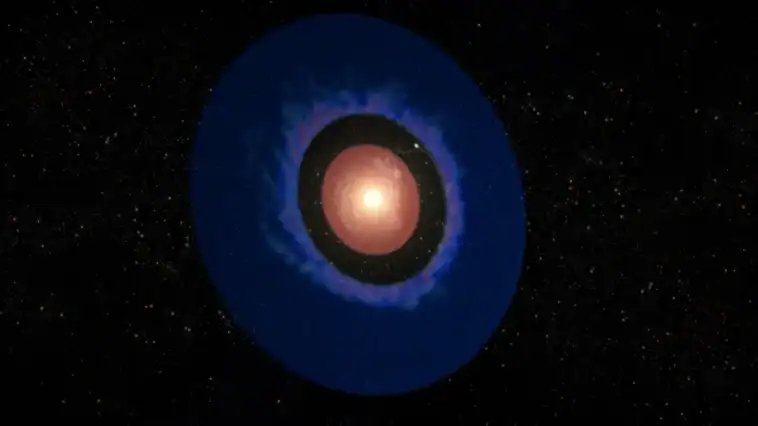
There’s a brand-new infant in the cosmic nursery, and it is officially breaking all the records as we know them. Astronomers using data from NASA-funded archives have confirmed the existence of a world called Elias 2-24 b. Coming in at less than one million years old, this new giant is the youngest exoplanet ever detected, offering scientists an unprecedented front-row seat to how planets are born and built from scratch.
Caught in the cosmic construction zone
To put Elias 2-24 b’s age into perspective, Earth is about 4.5 billion years old. A planet under a million years old isn’t just young, it’s practically a newborn still hanging out in the delivery room.
In fact, Elias 2-24 b is so young that, according to NASA, it is still whirling through its natal disk, the thick cloud of gas and dust that surrounds a newly formed star. The planet, located roughly 450 light-years away from Earth, is actively vacuuming up material from the surrounding disk as it orbits its host star, while growing bigger by the day.
How astronomers made the discovery
Most exoplanets are discovered using the transit method, which spots worlds when they pass directly in front of their host star and briefly block out its light. But baby planets like Elias 2-24 b are heavily shrouded in cosmic dust, making traditional transit hunting nearly impossible (this is more evident in the fact that the overwhelming majority of the 6,000 currently confirmed exoplanets are billions of years old). Instead, astronomers had to look for a world carving out a clean pathway directly through its dusty nursery.
“The galaxy churns out new stars and planets continuously, so there are many in every stage of evolution,” said Lucas Cieza, a professor at the Instituto de Estudios Astrofísicos in Chile and one of the astronomers who detected the planet.“That means we can see the entire process in theory, but there is a large gap in what most telescopes can detect. We are mostly blind to these baby planets right now.”
Solving a decade-long cosmic puzzle
Finding this record-breaking world wasn’t a sudden fluke. It took astronomers a decade of cosmic sleuthing across multiple observatories:
- The first clue (ALMA): About ten years ago, the Atacama Large Millimeter/submillimeter Array (ALMA) in Chile took sharp images of the young star Elias 2-24, spotting a distinct, empty gap inside its swirling dusty disk.
- The faint light (VLT): Shortly after, the European Southern Observatory’s Very Large Telescope (VLT) spotted a faint point of light sitting directly inside that gap. Scientists speculated it could be a planet carving out a path. However, theories doubted a world could form that quickly or that far out.
- The archive breakthrough (Keck): To confirm the discovery, researchers searched through the NASA-funded Keck Observatory Archive for observations taken in 2018 and 2020. By stitching those images together and using coronagraphs to block out the blinding glare of the host star, the team tracked the object’s movement over time.
The verdict?
The faint glowing dot wasn’t an imaging glitch or a distant background star—it was an actual planet moving in lockstep with the gap in the disk. “The planets should be found within the gaps, since they are carving them,” noted team member Bernardi. “And that’s exactly where we found Elias 2-24 b.”
Breaking all the planet-building rules
Beyond smashing records, Elias 2-24 b is throwing a massive wrench into our current models of how giant planets form.
Standard astronomical theories suggest that building a gas giant as massive as Jupiter takes around five million years, especially at distances far away from a host star. Yet Elias 2-24 b sits at a whopping 55 times the Earth-Sun distance, completely formed and hoovering up dust in under a single million years.
“Our planet-formation models already struggled to explain the previous record holders,” scientists noted, highlighting how Elias 2-24 b proves our existing theories are still missing important physical processes. Finding a massive planet so far out, so early in a star system’s lifespan, means cosmic construction happens much faster and more dynamically than anyone anticipated.
A window into our own origins
Studying this system isn’t just about cataloging deep-space record breakers; it acts as a literal time machine. By watching Elias 2-24 b clear its path and devour surrounding gas, astronomers get a direct look at what our own solar system likely looked like billions of years ago when Jupiter and Saturn were still growing inside the Sun’s primeval disk.
While Elias 2-24 b currently sits right at the razor’s edge of what current ground-based telescopes can detect, future space observatories—like NASA’s upcoming Nancy Grace Roman Space Telescope—are equipped with advanced coronagraphs designed to pull faint baby planets out of dusty clouds with ease.
As astronomers search through archival data and gear up for next-gen space missions, Elias 2-24 b stands as living proof that our galaxy is continuously creating new worlds. And this cosmic baby boom may be happening faster than we ever imagined.
Sources: NASA, IOP Science