
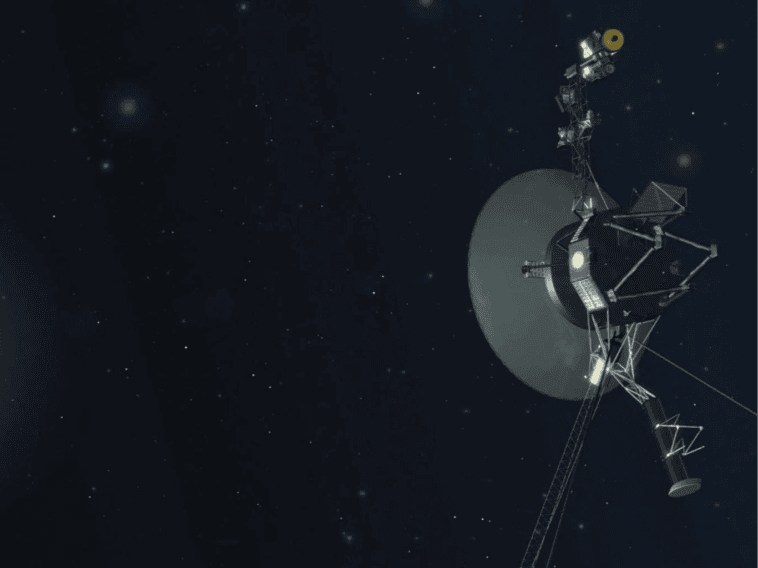
Somewhere more than 13 billion miles from Earth, a nearly 50-year-old spacecraft is still doing its job. Voyager 2 has been flying through space since 1977, survived four planetary encounters, crossed into interstellar space and continued sending scientific data back to Earth long after anyone could reasonably have expected it to.
Now, its biggest threat isn’t deep space—it’s running out of power. But NASA engineers at the Jet Propulsion Laboratory just found a clever way to squeeze another year out of its dying power supply. It’s all thanks to a carefully choreographed power-saving maneuver known as the “Big Bang” that should allow Voyager 2’s three remaining science instruments to keep working for at least another year.
Voyager 2 is running out of juice
Voyager 2 does not have solar panels. At its current distance from the Sun, sunlight is far too weak to be useful anyway. Instead, the spacecraft gets its electricity from three radioisotope thermoelectric generators, or RTGs. They convert the heat produced as plutonium-238 slowly decays into electrical power.
It’s an ingenious system, but the plutonium keeps decaying. Hence, Voyager 2 loses roughly four watts of available power every year.
Over the years, NASA has had to turn off heaters, instruments, and other systems that aren’t essential to keeping the mission alive. Since 2024, the shrinking power supply has forced the Voyager team to switch off two science instruments on each spacecraft. Voyager 2 was heading toward another shutdown before the end of 2026. Until engineers found a workaround.
Enter the Big Bang
The wonderfully dramatic name refers to a surprisingly delicate bit of engineering. NASA engineers shut down certain powered devices and switched their functions to alternatives that consume less electricity. The team also had to make sure the spacecraft wouldn’t become too cold in the process.
That’s because conserving power isn’t as simple as flipping switches. Voyager 2 is operating in an environment where temperatures are brutally low, and some of its systems need heat to continue functioning. Save too much electricity in the wrong place and you could create an entirely different problem.
The engineers essentially had to decide where every watt should go. The payoff is that Voyager 2’s three remaining science instruments can now continue operating for at least another year instead of losing another instrument before the end of 2026.
NASA plans to perform a similar power-saving maneuver on Voyager 1 in the coming months.
Voyager 2 is very, very far away
The spacecraft is now more than 13.2 billion miles from Earth, or roughly 21.4 billion kilometers. At that distance, even a radio signal traveling at the speed of light needs almost 20 hours to reach Voyager 2.
That means when NASA sends a command, engineers have to wait nearly 40 hours to send the instruction and receive a response. Imagine troubleshooting a laptop where every click takes almost a full day to get a response. That is essentially the Voyager team’s job. And despite the distance, Voyager 2 is still communicating with Earth and returning scientific measurements.
On November 5, 2018, the spacecraft crossed the heliopause, the boundary where the Sun’s solar wind gives way to interstellar space. It became only the second spacecraft to reach interstellar space, after Voyager 1.
This wasn’t supposed to last this long
Voyager 2 launched from Cape Canaveral on August 20, 1977. Its original mission was focused on the outer planets, but NASA got extraordinarily lucky with the timing. A rare alignment of the outer planets created an opportunity for the spacecraft to use their gravity to slingshot from one world to the next.
Voyager 2 flew past Jupiter in 1979, Saturn in 1981, Uranus in 1986 and Neptune in 1989. And it did something no other spacecraft has done by becoming the first and still only spacecraft to visit Uranus and Neptune. At Uranus, Voyager 2 revealed a strange world of rings, moons, and a turbulent atmosphere. It returned thousands of images from the encounter. Then it reached Neptune.
On August 25, 1989, Voyager 2 passed about 4,800 kilometers above Neptune’s cloud tops. The spacecraft found powerful winds, a giant storm system dubbed the Great Dark Spot and previously unknown moons and rings.
Once the planetary tour was over, NASA could have called it a day. Instead, Voyager 2 kept going.
Keeping a 1977 computer alive with engineering wizardry
Voyager 2 was built when personal computers were barely entering the mainstream, the first Star Wars movie was still in theaters, and nobody had a smartphone because smartphones were the stuff of science fiction. Yet the spacecraft is still communicating across more than 13 billion miles of space.
Its engineers have spent decades learning how to work around aging hardware, dwindling power and enormous communication delays. Every new shutdown and power-saving trick extends a mission that was never designed to last this long.
On August 20, Voyager 2 will mark 49 years in space. And it will be going farther away. For now, NASA’s goal is to keep the spacecraft warm, keep its antenna pointed toward Earth, and keep those three remaining science instruments collecting data. As long as Voyager 2 still has a few watts to spare, the agency is not ready to stop listening.
Sources: SciTechDaily, Aerospace Global News