
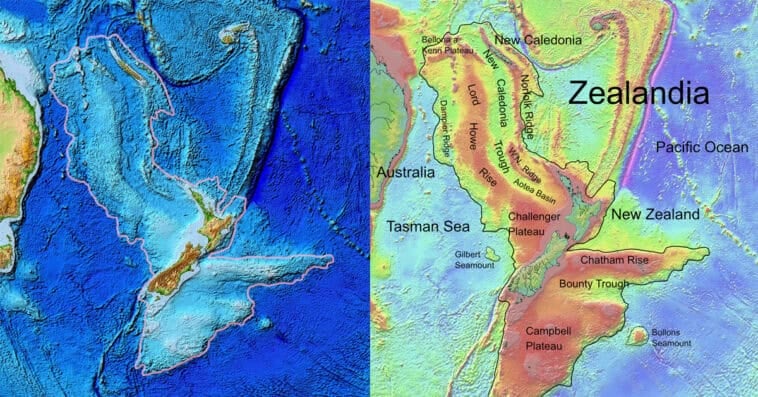
For centuries, humanity believed Earth had only seven continents, but scientists now say a massive hidden landmass nearly 1.9 million square miles wide has been quietly sitting beneath the South Pacific all along. Known as Zealandia, this mysterious underwater world has remained largely invisible beneath the ocean, with only small portions like New Zealand peeking above the surface. Now, new geological findings are finally revealing the true boundaries of what researchers believe could be Earth’s long-lost eighth continent, and the discovery is reshaping everything scientists thought they knew about the planet’s ancient past.
How Zealandia disappeared beneath the ocean
Scientists believe Zealandia’s story began more than 100 million years ago, when Earth’s continents were joined together in a gigantic supercontinent called Gondwana. This enormous landmass included what are now South America, Africa, Antarctica, Australia, and parts of Asia. Over millions of years, Gondwana slowly broke apart, and one drifting fragment eventually became Zealandia.
Researchers led by Nick Mortimer found that powerful tectonic movements gradually pushed Zealandia away from West Antarctica around 85 million years ago, before it later separated from Australia. As the landmass became isolated, its crust stretched, thinned, and cooled over time. That weakening caused much of the continent to slowly sink beneath the ocean’s surface.
New evidence strengthens Zealandia’s continental status
For decades, many geologists suspected this vast underwater region was more than just a collection of scattered fragments. However, without definitive proof, the scientific community hesitated to label these submerged plateaus and ridges as a true continent, often dismissing them as mere remnants of larger landmasses.
That perspective has shifted thanks to modern technology and fresh data. Researchers utilized geochronology, a specialized technique that measures the radioactive decay in minerals to pinpoint the exact age of rocks, to build a precise timeline of the region’s birth.
“By dating these rocks and studying the magnetic anomalies they presented, we were able to map the major geological units across North Zealandia,” the researchers explained.
By pulling samples from the seabed using sophisticated dredging equipment, the team recovered sandstone, volcanic pebbles, and basaltic lavas. These materials, which date back as far as the Early Cretaceous and Eocene periods, provided the smoking gun evidence needed. The findings confirm that this hidden mass possesses the same geological DNA found in the seven continents we recognize today, finally solidifying its status as a distinct world of its own.
Magnetic evidence helps reveal Zealandia’s true form
Scientists also relied on magnetic data to uncover the hidden structure of Zealandia beneath the ocean. By studying unusual magnetic patterns buried deep under the seafloor, researchers identified traces of ancient volcanic activity that helped outline the submerged continent’s boundaries.
These magnetic signals closely matched the ages of rocks collected from dredged samples, including large areas of intraplate basalt formed during the Cretaceous and Eocene periods. The discovery gave researchers stronger evidence that Zealandia is far more than scattered pieces of oceanic crust.
Instead, the organized geological patterns showed that the underwater landmass has the same kind of structure seen in recognized continents, further supporting Zealandia’s status as Earth’s hidden eighth continent.
Why scientists are fascinated by Zealandia
Researchers believe Zealandia offers a rare opportunity to better understand how continents change and evolve as Earth’s tectonic plates shift over millions of years. Because most of the landmass remains hidden beneath the ocean, it has preserved geological evidence that may no longer exist on continents exposed above sea level.
“Zealandia’s underwater status in no way diminishes its geological significance,” stated a GNS Science researcher.
Scientists say the submerged continent provides important insight into how plate movements can reshape continents over time. Studies of Zealandia’s sedimentary rocks show that some areas likely remained above water long after the landmass split from neighboring continents during the Late Cretaceous period. Meanwhile, basalt samples point to younger waves of volcanic activity that appeared as new tectonic plate boundaries developed.
Even with recent breakthroughs, much of Zealandia remains unexplored beneath the South Pacific Ocean. Researchers believe advanced tools such as seismic imaging and deep-sea drilling could reveal even more about the submerged continent’s structure, history, and formation in the years ahead.
Future international studies and field expeditions are expected to further explore Zealandia’s role in global tectonic activity and continental movement. At the same time, the discovery continues to spark debate among scientists over what truly qualifies as a continent.