
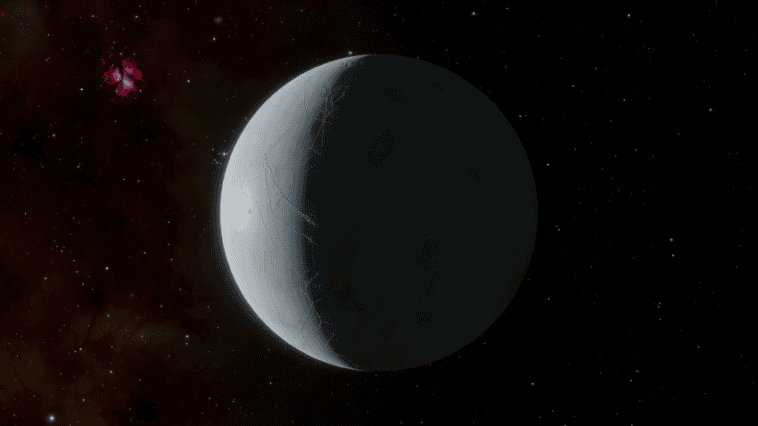
The hypothetical Planet Nine might have company in the dark. A team of astronomers thinks a second unseen planet, this one roughly one to two times the mass of Earth, could be drifting around the far edge of the solar system.
They’re calling it Planet X2. Scientists haven’t actually spotted it: what they’ve found are the odd orbits of icy rocks way out past Neptune, some tipped at strange angles and others that never swing anywhere close to the Sun. Researchers believe something has to be pushing them around.
“Imagine discovering, after decades of mapping our Solar System, that another planet has been hiding from us all this time,” lead researcher Patryk Sofia Lykawka said in a statement.
In their paper published in the Monthly Notices of the Royal Astronomical Society, the team led by Lykawka (primarily of Kindai University in Japan, with an adjunct role at the University of Southern Queensland) alongside Jonti Horner of the University of Southern Queensland and Pedro Bernardinelli of the University of Washington tried to rebuild the outer solar system on a computer, running it forward through 4.5 billion years.
With just the planets we know about, the weird orbits never showed up. Throw in one more planet far out in the dark, though, and they started to appear: a world that would weigh one to two times as much as Earth and stay hundreds of times farther from the Sun than we are.
“If this planet exists, it could change how we understand the history of our Solar System and how its most distant objects came to follow such unusual orbits,” Lykawka noted.
And no, it doesn’t knock Planet Nine off the table. The two ideas explain different oddities, so there’s room for both, or neither.
While the model is not definitive proof, the researchers view it as a strong foundation for future observations. “The exciting thing is that we now have an opportunity to put this idea to the test,” Horner said in a statement, pointing toward upcoming sky surveys.
The real test could come from the Vera C. Rubin Observatory in Chile, which is expected to discover far more icy bodies lurking beyond Neptune. If Planet X2 is out there, the pattern should get easier to see. Spotting the planet itself would be a much bigger ask, however.
Sources: Monthly Notices, Royal Astronomical Society, University of Southern Queensland, ScienceAlert