
While NASA pushes forward with its nuclear-powered engine concepts and researchers hunt for clever orbital shortcuts to slash Mars travel time, Russian scientists say they’ve come up with something even bolder.
Rosatom, the state’s nuclear corporation, claims to have built a rocket engine that could carry a crew to Mars in just 30 to 60 days.
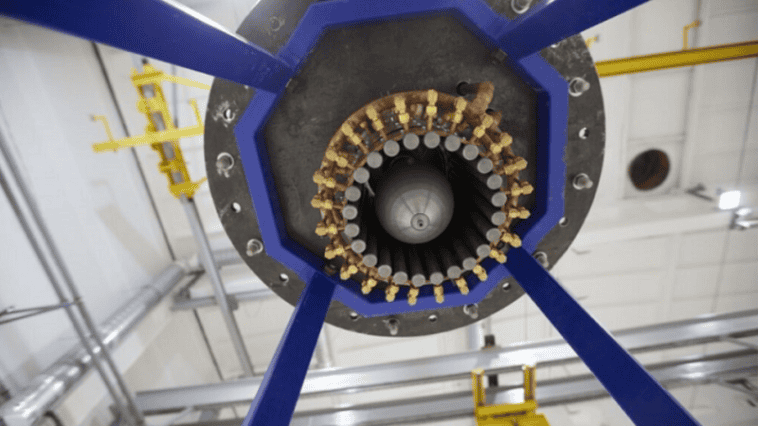
The team has already developed a working prototype at its lab in Troitsk. Unlike conventional rockets, nothing burns inside it. Instead, the engine operates on plasma, in which an electromagnetic field accelerates charged particles of hydrogen fuel out the back to generate thrust.
“At present, a one-way travel to Mars on board a spacecraft with conventional engines can take almost a year, which poses a significant risk to astronauts considering cosmic radiation exposure. However, plasma engines could reduce the duration of flights to just 30 to 60 days, making possible return missions to Mars,” said Alexei Voronov, first deputy director for science at Troitsk Institute (TRINITI), in a statement.
“The creation of a prototype is a crucial milestone of the project as it shows whether the engine is suitable for future ‘nuclear tugs’ in space and whether it is possible to reduce the cost of their production,” he added.
The plasma advantage
A regular chemical rocket can only fling its exhaust out at a few kilometers per second. The plasma version is designed to leave that far behind.
Because this process is energy-intensive, requiring an estimated 300 kW of power, the engine would necessitate a robust, space-based nuclear reactor to function effectively.
The benefit would be significant if things worked out because it would mean a much faster crossing and less time for the crew to soak up dangerous space radiation. That said, it is all still a bench prototype at this point, and no one outside Rosatom has independently verified the performance figures. But those numbers are the entire selling point.
A flight-ready version, if it ever happens, is pegged to 2030. The plasma-backed engine couldn’t launch on its own either way, as conventional rockets would still be needed to reach orbit since the plasma drive can only activate once the spacecraft is safely in space.
Russia’s hardly the only one pursuing advanced propulsion. An Italian team’s tinkering with a thruster that runs on water, while NASA and other organizations continue exploring lightsail concepts, which use lasers and sunlight for propulsion.
However, none of these technologies is anywhere close to flying crewed missions to Mars.
Sources: Rosatom, Izvestia, Interesting Engineering, World Nuclear News