
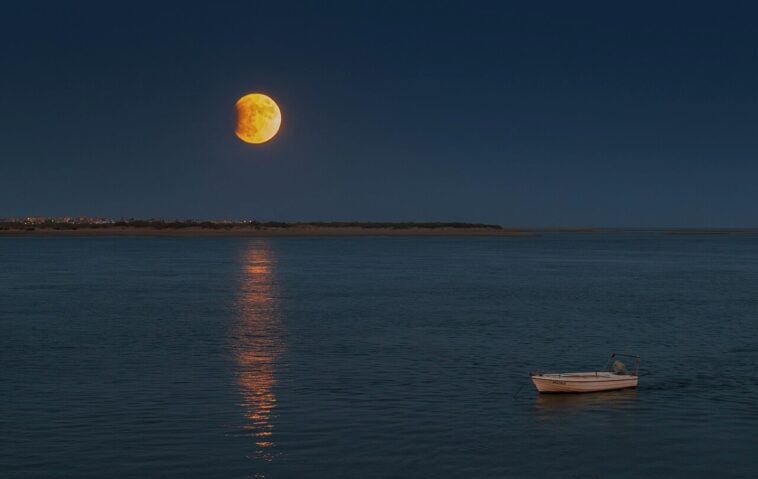
Nearly a billion people across the Americas will have a front-row seat Thursday night to witness the moon almost disappear.
Earth’s shadow will cover 96% of the lunar surface in this unusually deep partial eclipse whose full run, from the moment the moon touches the faint outer edge of the shadow to the moment it leaves, lasts 5½ hours. The more dramatic partial phase itself will last for more than three hours, with the eclipse peaking just after midnight at 12:12 a.m. EDT.
This is the second act in a close pairing where two solar eclipses and two lunar eclipses occur in 2026, creating a rare, double dose of celestial drama. Two weeks ago, on August 12, a total solar eclipse swept across Greenland, Iceland, and northern Spain.
Eclipses come in pairs because the sun, moon, and Earth line up with precise enough alignment that one blocks the other, a cosmic coincidence that only works because the moon is 400 times smaller than the sun and 400 times closer.
Catching the cosmic show
More than 3 billion people, 44% of the world, will catch at least part of this lunar eclipse, provided the skies are clear. North and South America get prime viewing, with the full show unfolding as the moon is high in the night sky.
Views in Europe, Africa, and the Middle East, meanwhile, will be cut short because the moon will already be setting during the event in these places. In Hawaii and the northwestern edges of the US and Canada, however, the show will start late, as the moon will have risen by then.
Because this is a partial rather than a total eclipse, the alignment won’t be perfect, meaning the event will not produce a true blood moon. Earth will still pass between the moon and sun, throwing a reddish-orange light into Earth’s shadow and painting the lunar surface a coppery glow.
Ten people currently living off the planet might get their own view. Seven are aboard the International Space Station (ISS), and three are on China’s outpost, the Tiangong space station.
NASA astronaut Jack Hathaway, while speaking to the Associated Press from the ISS recently, summed up the excitement succinctly: “This is a great time to be part of the space program, right? We’re not slowing down.”
A busy stretch for Earth’s companion
The moon has been getting a lot of attention lately. NASA’s Artemis II crew aboard the Orion spacecraft, Integrity, returned in April 2026 after setting a new record for the farthest humans have ever traveled from Earth during their lunar flyby, ahead of a planned landing and a base meant to eventually house people and robots.
This lunar eclipse marks the year’s second lunar eclipse and the fourth eclipse overall, following a total lunar eclipse in March that crossed the Americas, Australia, and eastern Asia. The next full lunar blackout isn’t until New Year’s Eve 2028, centered on Asia and Australia. North and South America, meanwhile, won’t be seeing another total lunar eclipse until 2029.
Sources: NASA Eclipse Data, Lunar Eclipses Worldwide, NASA (Future Eclipses), Artemis Lunar Flyby, New York Post