
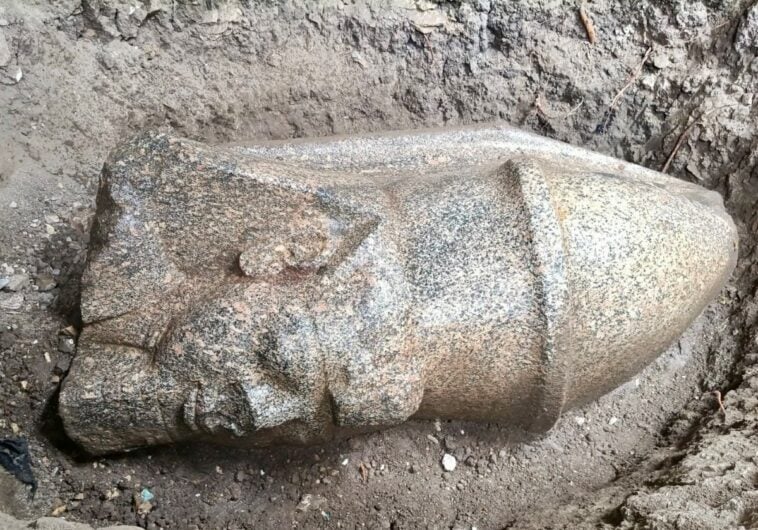
An Egyptian farmer has uncovered pieces of two statues of Ramses II (the legendary pharaoh frequently associated with the biblical Exodus) while working the land outside his home in Behbeit El Hagar, a village in the Nile Delta province of Gharbia, located north of Cairo.
According to the Egyptian Gazette, the farmer found a carved stone block while tilling the soil and reported it to local antiquities officials, prompting a team from Egypt’s Supreme Council of Antiquities (SCA) to launch emergency excavations at the site.
The excavation revealed a head of Ramses II that is approximately 5.3 feet tall, showing the king wearing the double crown of Upper and Lower Egypt, a symbol of rule over the entire country. Archaeologists estimate that the full statue, including its base, would have stood at about 27.9 to 28 feet tall.
Nearby, the team also uncovered a second royal statue, just under eight feet tall. Though its legs and base are missing, the face remains intact and is framed by the nemes, the striped cloth headdress worn by Egyptian kings. The SCA believes this statue also depicts Ramses II because its features closely match those of the larger statue.
A block of pink granite about four feet high was found at the site as well. It bears fragments of hieroglyphic inscriptions, including two royal titles: “Nesu Beti,” meaning King of Upper and Lower Egypt, and “Sa Ra,” meaning Son of Ra.
Ramses II, born around 1303 B.C., is regarded as one of the most powerful rulers of Egypt’s New Kingdom (roughly 1570 to 1069 B.C.) and is often associated with the unnamed pharaoh in the biblical Book of Exodus who enslaved the Israelites and opposed Moses.
Sherif Fathy, Egypt’s Minister of Tourism and Antiquities, said he hopes the newly uncovered finds will add to what is known about this part of the Nile Delta, which served as an important political, cultural, and economic center in ancient Egypt. Officials say the statues and the site will be studied further.
Sources: Ministry of Tourism and Antiquities (X), Ahram Online, Egyptian Gazette, New York Post