
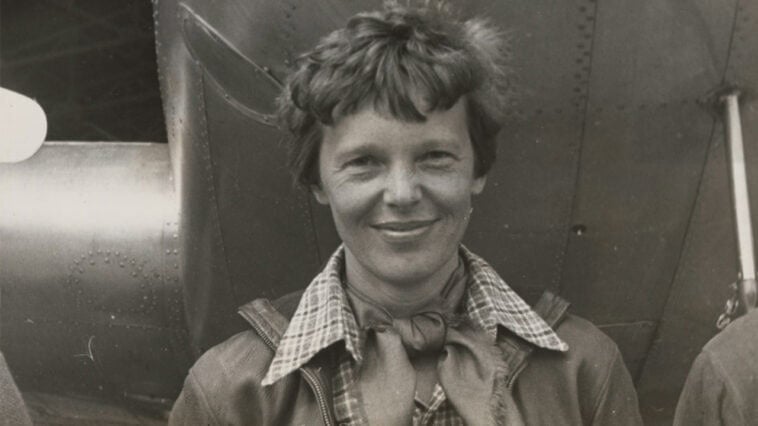
Nearly 90 years after Amelia Earhart vanished during her attempt to fly around the world, a new expedition is diving into the waters near a remote Pacific island in hopes of finding her missing aircraft. Researchers believe a mysterious object spotted in aerial and satellite images could hold the key to one of aviation’s greatest unsolved mysteries. But the search will not be easy, with extreme weather, challenging terrain, and giant coconut crabs complicating the mission. Could this expedition finally uncover what happened to the legendary pilot? Read on to discover what the team hopes to find.
Researchers investigate a mysterious object near a remote Pacific island
A team from the Archaeological Legacy Institute (ALI) and Purdue University has arrived at Nikumaroro, a remote island in the Pacific nation of Kiribati, to investigate a mysterious object that could offer new clues about Earhart’s disappearance in 1937.
The expedition reached the island aboard the Marin Mainiku on Monday after a five-day voyage covering approximately 830 nautical miles across the South Pacific. Researchers have about five days to inspect the suspected wreckage, although difficult weather conditions and potentially dangerous wildlife could complicate their work.
The team is focusing on an object known as the Taraia Object, which appeared in satellite imagery in 2020 near the edge of a lagoon on the island. Some researchers believe it could be part of Earhart’s aircraft, while skeptics argue that it may be a collapsed tree or something unrelated to aviation.
The mission marks the first authorized expedition to Nikumaroro in seven years and the first visit to the Taraia Peninsula in more than 15 years, according to Purdue University.
“It is incredibly rewarding to be this close to completing our inspection of the Taraia Object and potentially solving, at long last, the outstanding mystery of the disappearance of Amelia Earhart and Fred Noonan more than 89 years ago,” expedition leader Rick Pettigrew said in a blog post on Monday.
A challenging search in unpredictable conditions
The researchers must overcome several logistical hurdles before they can examine the suspected wreckage. On Tuesday, the crew planned to pass through a narrow opening in the island’s coral reef. British authorities blasted the channel in 1963, when the island was last inhabited, according to the expedition account.
The initial work involves moving equipment ashore, clearing vegetation, and setting up a base for the investigation. One group will cut a path through the dense jungle to help researchers reach the search area.
On Wednesday, the team plans to look for evidence on the Taraia Peninsula, including metal objects that could be detected with magnetic equipment. Researchers will then use dredging tools to move sediment and improve visibility around the mysterious object.
The suspected wreckage is believed to lie about 10 feet from shore, in water that may be as shallow as five feet, depending on the tides. However, the team’s schedule could change as weather and sea conditions evolve.
Michael Krivor, a marine archaeologist participating in the expedition, said he is particularly concerned about an east-to-west-moving weather pattern that could affect “safe transit in and out of the blasted channels”.
The researchers are also monitoring the effects of El Niño, a climate phenomenon that can alter weather patterns across the Pacific. Conditions associated with the event could restrict how often the crew can safely reach the island.
Giant coconut crabs pose another threat
Beyond the weather, the expedition faces an unusual obstacle: giant coconut crabs, also known as robber crabs. These powerful crustaceans are the largest land-dwelling crabs and are active at night, when they search for food, including small mammals and seabirds.
Their size and nocturnal habits mean the researchers cannot safely remain on the island overnight. Instead, the team will return to the Marin Mainiku each evening.
“The crew will sleep nightly aboard the Marin Mainiku for a number of reasons, one of which is the presence of coconut crabs, whose size and overnight activity make staying on the island impractical,” the expedition’s blog post explains.
Coconut crabs can weigh more than 4 kilograms (9 pounds), measure up to a meter (3.3 feet) across their legs, and climb trees. They are also capable of lifting objects weighing as much as 28 kilograms (62 pounds). Although coconuts are a major part of their diet, they also prey on animals such as rats and birds.
The crabs have even featured in theories about Earhart’s fate. Some researchers have suggested that she may have survived a crash on Nikumaroro before dying on the island, where the crabs could have scattered her remains.
In 2018, the International Group for Historic Aircraft Recovery used pig carcasses in an experiment to investigate this possibility. The demonstration showed that coconut crabs could drag remains into their burrows and strip bones of flesh in less than two weeks.
However, the theory remains unproven, and the presence of the crabs does not establish that Earhart ever reached the island.
What happened to Amelia Earhart?
Earhart was already a celebrated aviator when she set out to fly around the world with navigator Fred Noonan in 1937. After crossing parts of South America, Africa, and Asia in her twin-engine Lockheed Electra, she arrived in Lae, Papua New Guinea, on July 2 that year.
Her next planned destination was Howland Island, a small, remote island in the Pacific where the pair intended to refuel. They never arrived. The aircraft disappeared while they were attempting to reach the island, triggering one of aviation history’s most enduring mysteries.
The widely accepted explanation is that Earhart and Noonan struggled to locate Howland Island because of navigation and radio communication problems. With fuel running low, their aircraft is believed to have crashed into the ocean.
Other theories suggest that the pair may have landed elsewhere in the Pacific and died after reaching an isolated island. Nikumaroro has attracted particular interest among researchers investigating these possibilities.
The Taraia Object could provide an important new lead, but its identity has yet to be confirmed. Establishing whether it is aircraft wreckage will require careful examination, and even a discovery of metal debris would not automatically prove a connection to Earhart’s flight.
For now, the expedition’s goal is to determine what the mysterious object actually is. If investigators find convincing evidence linking it to her aircraft, the discovery could help narrow the search for answers about what happened to Earhart and Noonan nearly nine decades ago.
Sources:
Purdue University
BBC