
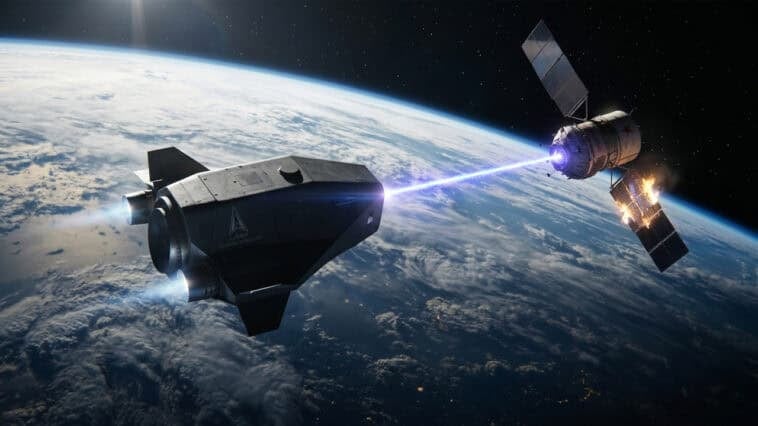
A war in space could start within the next five years, pushing life back to the nineteenth century, experts warned this week at a London meeting organized by Astroscale UK, the British subsidiary of a company set up to clear debris from Earth’s orbit.
Reflecting that concern, some British firms that were originally built for civilian work in orbit are already moving into defense.
Dr. Julia Balm, a space defense specialist at King’s College London’s Freeman Air and Space Institute, warned during the briefing that allied countries are being “targeted” in space by adversaries “on a daily basis.”
The warning mirrors recent assessments from UK Space Command, whose leadership has repeatedly described orbit as a contested operational domain subject to daily electronic and cyber interference.
Astroscale is now working on classified military programs that could use its technology to watch or deter hostile spacecraft, and Orbit Fab, a company that refuels satellites, is working with the Ministry of Defense on similar efforts.
Defense takes center stage
Nick Shave, Astroscale UK’s managing director, said the company had no military ambitions when it started out in 2013. That changed after the UK’s strategic defense review warned about war in space. For the past 20 or 30 years, Shave noted that commercial operators could place satellites in orbit reasonably confident they would not be attacked, an assumption that no longer holds.
One option could be sending payloads to scare off aggressive spacecraft, much like the chaff that’s used to throw off guided missiles, Shave explained.
Much of daily life depends on satellites. If communications or GPS went down, air traffic control, the internet, television, and weather forecasts could all stop working. That vulnerability is growing as Russia, China, and the U.S. become more active in orbit.
Last month, U.S. Air Force Secretary Troy Meink confirmed the U.S. had put a weapon in space for the first time. Meanwhile, U.S. intelligence agencies suspect a Russian satellite launched in 2022 may be carrying parts of a nuclear device. At the same time, China’s Shenlong space plane has been seen practicing how to capture objects.
In September, the Royal Air Force responded by standing up its first dedicated active-defense space squadron to protect Britain’s satellites.
Sources: Air & Space Forces Magazine, Official GOV.UK, WSJ, Defence Blog, Astroscale, The Telegraph