
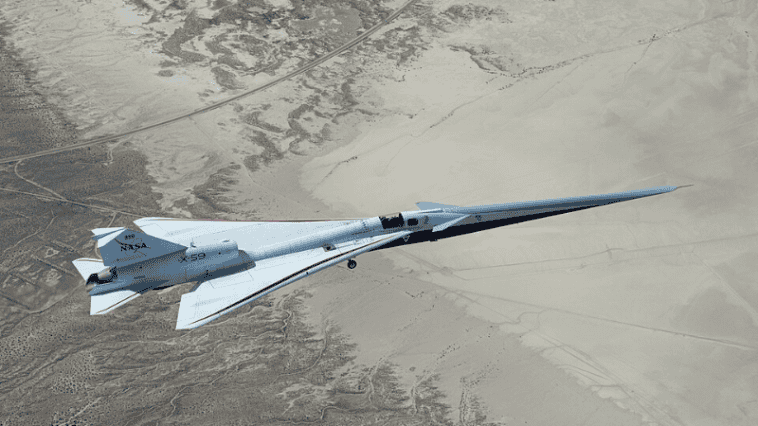
After decades of thunderous sonic booms keeping supersonic flight grounded over U.S. cities, a sleek experimental jet from NASA is finally ready to rewrite the rules in the skies.
The space agency’s X-59 jet is expected to break the sound barrier for the first time this month.
The X-59 is designed to fly supersonic without producing a loud sonic boom. Its long, narrow fuselage is meant to spread out the shockwaves so the noise reaching the ground is softer.
NASA hopes the aircraft will prove that quiet supersonic flight is possible, paving the way for supersonic planes to operate over land once again.
The countdown to Mach 1.4
For its initial supersonic flight, the jet is expected to first exceed Mach 1 (over 630 mph) at approximately 43,000 feet. This will be followed by a “mission conditions” flight reaching Mach 1.4 (about 925 mph) at 55,000 feet.
With the aircraft now ready for its biggest test yet, project officials are preparing for a historic milestone.
“What comes next is the first time this one-of-a-kind aircraft will fly supersonic,” said Cathy Bahm, project manager for NASA’s Low Boom Flight Demonstrator, in a statement. “We are starting toward the mission conditions test point that X-59 was designed for,” she added.
The road to the runway
The X-59 completed its maiden flight in October 2025, followed by a scheduled maintenance period. It returned to the skies in March 2026 and has since flown 14 times, all subsonic, with a top speed of Mach 0.95 so far. Then last month, the jet was able to retract its landing gear for the first time and also completed two flights in a single day.
The aircraft also features a unique cockpit design. It has no forward windscreen, as its extremely long nose would make it impossible for the pilot to see directly ahead. Cameras instead relay a live view to a screen in the cockpit, a setup NASA calls the eXternal Vision System.
The testing conducted so far has been part of “Phase 1,” which focuses on whether the plane is safe to fly. Phase 2 testing is scheduled to begin later in 2026 and will involve measuring how loud the sonic boom actually is for people on the ground.
This data will be critical in NASA’s effort to overturn the long-standing ban on supersonic flight over land. Such flights have been prohibited in the U.S. since 1973 because of the disruptive noise from traditional sonic booms. NASA hopes the X-59’s quieter design will help lift that restriction.
Other companies are also pursuing quiet supersonic technology. Last year, Colorado-based Boom Supersonic flew its XB-1 demonstrator on the first supersonic test flight, the first civil aircraft to do so over the continental U.S.
Sources: NASA (AFRC), Boom Supersonic, Space, NASA Quesst Mission