
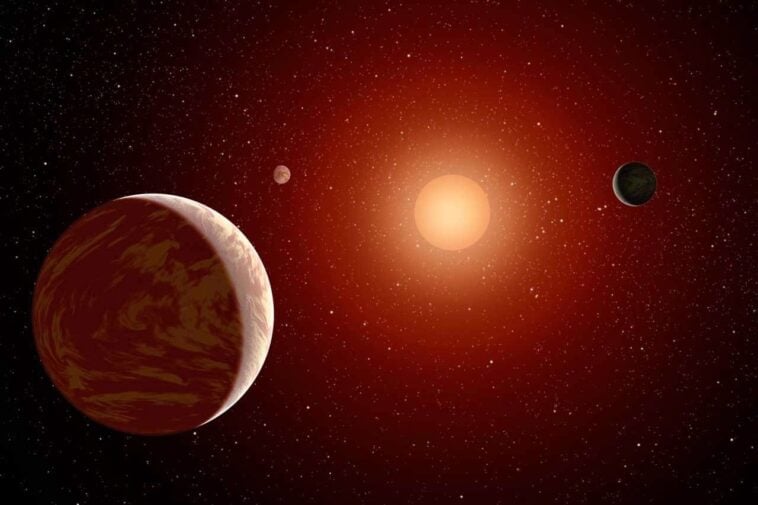
When you think about the phrase “Mega-Earth,” your mind probably jumps straight to a sci-fi blockbuster movie poster or a comic book alternate dimension. But astronomers just proved that huge, rocky monster worlds are not just a Hollywood fantasy. They are real, and one very weird specimen is turning planet-formation science entirely upside down.
Astronomers have officially cataloged a mind-bending new exoplanet named GJ 523b, and it is a celestial heavyweight that defies almost everything we thought we knew about planet formation.
What is an exoplanet, anyway?
Before we look at why this specific world is confusing experts, let’s refresh on the basics. An exoplanet is simply any planet that exists outside our solar system, orbiting a star other than our Sun.
Since the first confirmed detection back in the 1990s, NASA’s catalog of extrasolar worlds has exploded to thousands of confirmed planets. They come in all shapes and sizes. From “super-Earths” that are slightly bigger than our home world to puffed-up gas giants.
Occasionally, scientists stumble across a world so dense and massive that it earns the informal title of a mega-Earth. And GJ 523b isn’t just any mega-Earth. It is the concrete blueprint scientists have been waiting decades to find. It is a genuine mega-Earth, an informal term reserved for exceptionally rare, extraordinarily massive worlds that remain predominantly rocky instead of turning into gaseous giants like Jupiter or Saturn.
Meet GJ 523b: The mega-Earth 23 times Earth’s mass
First spotted when NASA’s Transiting Exoplanet Survey Satellite (TESS) caught it blocking out a bit of its host star’s light, GJ 523b was later confirmed using ground-based instruments like the WIYN 3.5-meter Telescope at Kitt Peak National Observatory, along with data from the James Webb Space Telescope.
A team led by Max Kroft, a graduate student working alongside Assistant Professor Thomas Beatty at the University of Wisconsin–Madison’s Wisconsin Center for Origins Research (WiCOR), analyzed the data and uncovered some truly shocking stats:
- Age: The planet system is practically a newborn at roughly 170 million years old.
- Size: It spans about 2.5 times the radius of Earth (or roughly 60% the size of Neptune).
- Mass: Its massive core packs roughly 23 times the mass of Earth!
- Density: It boasts an astounding density of about 126.82 grams per cubic inch (around 7.8 grams per cubic centimeter), proving it is overwhelmingly made of dense rock.
Because of its size, density and proximity to its star, GJ 523b circles its star every 17.75 days.
“This isn’t what we expected at all,” Kroft said in the statement. “Dense planets like this aren’t uncommon, but they’re usually small rocky planets similar to Earth or Mercury.”
The ultimate cosmic mystery
According to traditional planet-building models, a world like this shouldn’t exist as a rocky body.
Normally, when a growing protoplanet’s rocky core reaches about 20 times the mass of Earth, its gravitational pull turns into a giant vacuum cleaner. It should rapidly gobble up massive amounts of surrounding hydrogen and helium gas, swelling into a gas giant like Jupiter or Saturn.
Yet, despite easily blowing past that 20-Earth-mass threshold, 170-million-year-old GJ 523b somehow stayed almost entirely rocky, while holding onto only a surprisingly thin atmosphere.
How did such a monster form?
Since standard textbook science can’t easily explain it, researchers have floated two main theories for how GJ 523b became such a heavy outlier.
One possible theory is that the planet might have originally sucked up a thick gaseous shell, but because it orbits so close to its host star, intense heat stripped its gaseous atmosphere away.
Another explanation astronomers are considering is that two massive, rocky protoplanets might have collided head-on. The impact could have merged their heavy cores together while completely blowing off their lighter gas layers, leaving behind one massive, ultra-dense lump of rock.
“It kind of blows away,” Kroft explains. “A planet can’t hold on to its atmosphere if it’s really hot, and so you could be left with this big glob of rock made by these two planets with very little atmosphere.”
Whether it survived a brutal stellar beating or a world-shattering collision, GJ 523b is giving scientists their first concrete look at what a true mega-Earth really is. It is proving the universe is far stranger than our best computer models ever imagined.
Sources: Detroit free press, Space.com, University of Wisconsin–Madison