
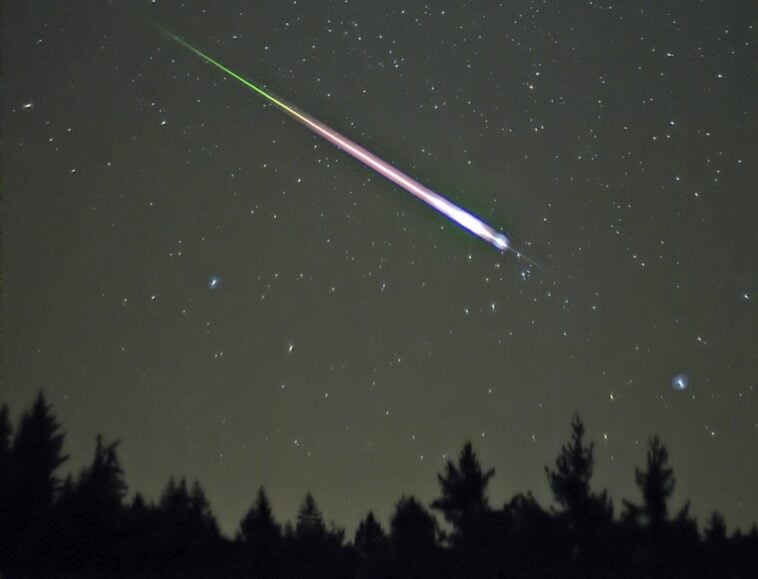
Stargazers have a chance to catch the Leonid meteor shower at its peak tonight, with the best viewing between midnight and dawn (around 5:30 a.m.) on Wednesday, Nov. 18.
The Leonids show up every November when Earth moves through the dusty trail of Comet 55P/Tempel-Tuttle. How many meteors people will see depends on who’s counting.
The International Meteor Organization (IMO) cites an ideal maximum of up to 15 per hour under pristine skies, while NASA cautions that real-world counts for casual observers are typically fewer than three.
Either way, the hours before sunrise are the time to go out. That’s when Leo, the constellation the meteors appear to fly out of, sits highest in the southeastern sky. The moon will be down by then, so the sky should be darker.
Fortunately, finding Leo should be easier than usual this year, because Jupiter and Mars will be sitting just a few degrees apart inside it. NASA advises taking in as wide a view of the sky as possible rather than staring directly at Leo, where trails appear shorter, and allowing up to 30 minutes in the dark for your eyes to fully adapt.
While overall meteor counts are low, the Leonids make up for it with quality: the shower is famous for bright fireballs and ‘persistent trains,’ which are glowing vapor trails that linger in the sky for seconds after a meteor streaks by.
Just don’t expect a full-blown storm tonight. While the shower occasionally erupts into legendary spectacles with thousands of meteors per hour, tonight will likely remain modest. According to The Planetary Society, the next true storm isn’t expected until 2031, with a recent August study suggesting 2033 and 2034 could bring the biggest shows.
Sources: NASA, IMO, The Planetary Society, Royal Observatory Greenwich, Space.com