
For decades, the search for Noah’s Ark has drawn explorers and researchers to a mysterious boat-shaped formation in the mountains of eastern Turkey. Now, a discovery is adding another intriguing twist to the long-running mystery: wood fragments that bear marks resembling those left by axes and knives, suggesting they may have been shaped by human hands. Some researchers believe the unusual markings could point to signs of ancient craftsmanship, potentially offering fresh clues about what lies beneath the site. But do these fragments really provide evidence of Noah’s Ark, or is there another explanation for their presence?
Researchers find possible evidence of human workmanship
The latest development comes from the U.S.-based research group Noah’s Ark Scans, which has focused its exploration on the Durupınar Formation. Located in eastern Turkey just south of Mount Ararat, the region where Genesis 8:4 states the biblical vessel came to rest, the 515-foot geological feature has long captivated Ark hunters due to its striking, ship-like shape.
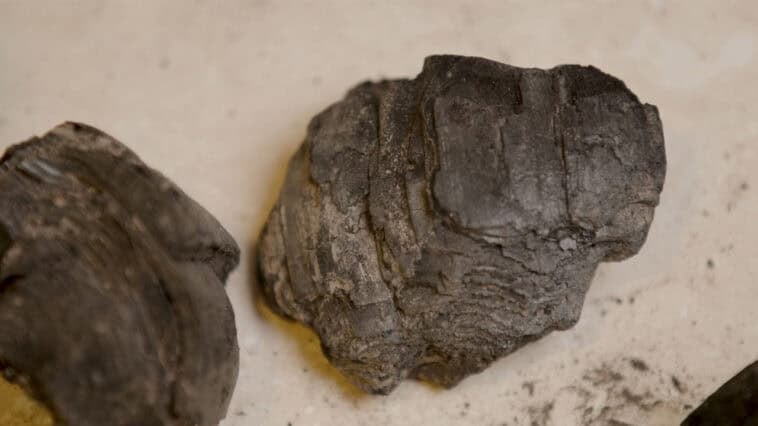
According to the team, researchers excavated several small bags of darkened, cracked, and heavily charred wood fragments from roughly 30 feet underground. While the samples still show visible grain patterns and growth rings, the group claims their edges tell a compelling story.
“The fragments display sharp, cut edges and other indications of intentional shaping, distinguishing them from naturally occurring or weathered wood,” Noah’s Ark Scans stated in an update, adding that the pieces exhibit “clear manmade marks consistent with tool work performed long ago.”
Professor Cenker Atila, an archaeologist at Turkey’s Sivas Cumhuriyet University who leads the research project, believes the wood is “very ancient” and ranks it among “one of the most significant discoveries” at the site. Inspecting the samples, Atila noted that at least one piece is “clearly [showing] signs of human workmanship,” adding, “Its surface appears to have been slightly shaped and flattened using an axe or a knife.”
For Noah’s Ark Scans founder Andrew Jones, the find represents a potential turning point. “After decades of searching, this could be a crucial piece of the puzzle,” Jones said. However, the team emphasized that “laboratory results will determine the next steps and that no final conclusions have been drawn.” The wood samples have been dispatched to four separate laboratories for independent testing, with a final expedition report slated for late spring next year.
The charred wood is just the latest piece of evidence the group has presented. Shortly before announcing the wood discovery, Noah’s Ark Scans released subsurface footage of what it suggested could be the vessel’s “hull”, which is described as “a distinct band following the boat’s outline” that “appeared different from the ground on either side of it.” Researchers interpreted this anomaly as “a possible outer shell, with mud inside and outside — the kind of pattern they said could fit a wooden boat buried in mud.”
To investigate further, Jones noted the team plans to analyze soil samples collected “at various depths to analyze its composition.”
These claims build upon a non-peer-reviewed preliminary report from the group’s ground-penetrating radar scans. In that report, Khosrow Bakhtar of Bakhtar Research and Engineering argued that the data reveals “organized patterns, corridors, chambers, and hallways lying inside the 515-foot boat-shaped Formation in the Mountains of Ararat.”
“Whatever the object is beneath the surface is extraordinary,” Bakhtar said. “In 40 years of this work, I have never seen anything like it. It could be a ship. It could be a spaceship. What I can say from the radar is that it is organized, it is structural, and a solid geological mass would not have returned such a strong signature.” He added that “if it was from geologic origin, we would have not seen it at all since we masked the subsurface geologic features.”
Scientific skepticism and natural explanations
Despite the team’s enthusiasm, mainstream geologists and archaeologists remain largely unconvinced, pointing to decades of research indicating the Durupınar site is a product of nature rather than ancient shipbuilding.
Viral claims tied to the Ark legend frequently face pushback from experts in the region, such as submerged ruins in nearby Lake Van, which online speculation linked to a biblical deluge before a local archaeologist debunked the theory.
At Durupınar itself, the U.S. Geological Survey notes that underground moisture anomalies often intrigue explorers, even though groundwater can naturally accumulate and become “isolated from the regional water table by low-permeability beds”.
But the most prominent scientific rebuttal dates back to 1996, when geologist Lorence Gene Collins teamed up with David Franklin Fasold, a former Ark believer who once argued the site’s dimensions were “exactly the same as prescribed in the Bible.” After conducting thorough testing, the pair published a paper titled Bogus Noah’s Ark from Turkey Exposed as a Common Geologic Structure, dismissing Fasold’s earlier claims as “circumstantial.”
“Evidence from microscopic studies and photo analyses demonstrates that the supposed Ark near Dogubayazit is a completely natural rock formation,” Collins and Fasold concluded. “It cannot have been Noah’s Ark nor even a man-made model.”
Despite this, Noah’s Ark Scans maintains that modern scanning and excavation technologies allow them to see what 1990s researchers could not. Whether the latest wood samples can support that argument remains to be seen. Until laboratory testing and further independent investigations are completed, the possibility that the Durupınar Formation contains Noah’s Ark remains unproven.
Sources:
Newsweek, Noah’s Ark Scans