
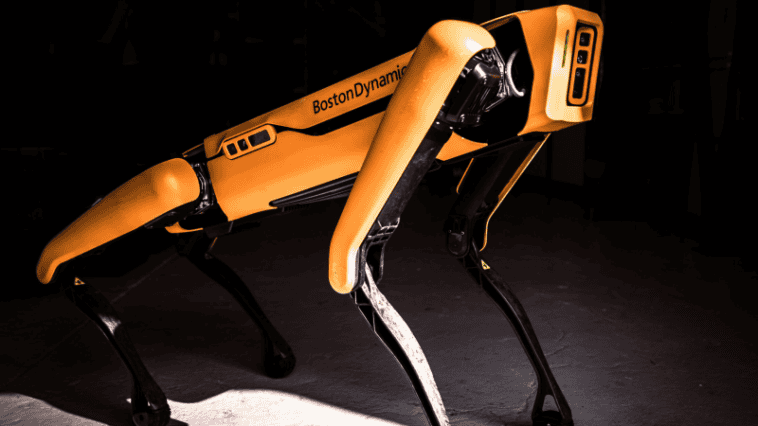
A DHS (Department of Homeland Security) document published recently reveals that ICE (U.S. Immigration and Customs Enforcement) is preparing to buy American robot design company Boston Dynamics’ SPOT robots, the four-legged machines commonly referred to as robot dogs.
The acquisition forecast, a tentative notice that alerts vendors of upcoming procurement needs, puts the deal’s value between $1 million and $2 million with a formal solicitation expected on September 4.
According to the document, the robots will handle inspection, situational awareness, and hazard assessment in places that put human personnel at risk. Officer safety is cited as the stated justification.
However, the forecast itself remains broad and says nothing about immigration enforcement. It also provides no specific operational scenarios for where or how the robots would be sent in.
What Spot does and won’t do
Boston Dynamics describes Spot, a roughly 75-pound unit that’s able to handle stairs and rough terrain, as an easy-to-use tool. It operates remotely and transmits real-time data with the help of thermal imaging, cameras, and mapping sensors (available as add-ons) as it goes.
While the DHS document remains vague on exactly how many robots ICE intends to purchase or which specific configurations they will order, the technology’s versatility has sparked immediate questions regarding its potential application.
The company appears to have preempted such concerns with its policy on misuse, stating it “will not authorize nor partner with those who wish to use our robots as weapons or autonomous targeting systems” and that it will take measures if its products do end up causing harm.
Similar robots already serve police departments, militaries and emergency agencies here and abroad, usually to check unstable or dangerous ground before people go in. For ICE, however, this lands amid a broader buildout covering facial recognition, automated license-plate readers, commercial data brokers, GPS ankle monitors, smartphone monitoring, voice recognition, and body cameras.
This continued and accelerated expansion of enforcement tech, which recently included a $16.7 million no-bid contract for 6,000 pairs of electric-shock gloves, has naturally drawn scrutiny from all quarters. The deal has also prompted Democratic senators to call on ICE Acting Director David Venturella to cancel the contract, pushing instead for “de-escalation tools, training, and accountability.”
Sources: Acquisition Planning Forecast System, Boston Dynamics, DHS, Washington Times, Newsweek