
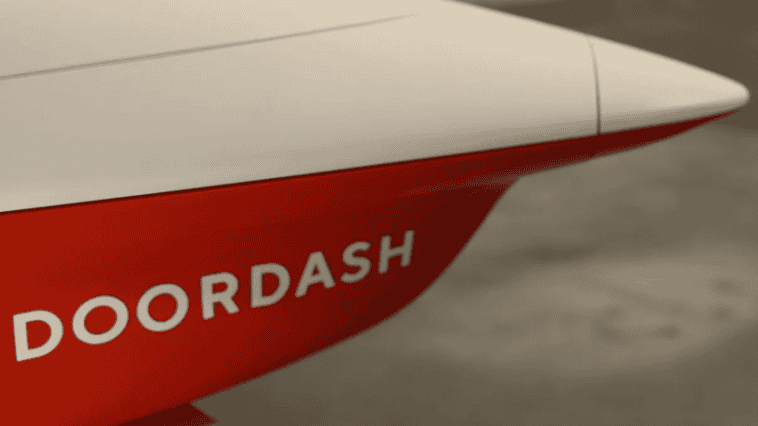
There’s a specific kind of DoorDash order that offers a persistent logistics problem. It’s far enough to be a hassle, but not far enough to make the trip worthwhile for drivers. To solve this, DoorDash is turning to the skies.
To that end, the company unveiled DoorDash Air recently, an in-house program building its own drone delivery system. The food delivery service also announced that it has secured Part 135 air carrier certification from the FAA as part of the launch, the paperwork that actually lets a company operate its own drone fleet. This is a privilege held by only eight operators so far.
Solving the ‘middle mile’
DoorDash calls these “mid-range” zones, i.e., orders between 3 and 5 miles, a critical operational gap. Such deliveries make up more than 20% of the company’s order volume and take about 25% longer than average, mostly because human couriers don’t want them. With last year’s pilot programs proving that drones can run that distance in about 25 minutes, the company now has clear proof of concept.
While DoorDash will continue its four-year-old partnerships with other drone companies, its new in-house design is meant to sit in the gap between the short- and long-range drones those partners already fly.
The harder part of the delivery process isn’t the aircraft. Since the company is also building the ground infrastructure, this means figuring out how a drone collects food from a drive-thru window, a rooftop, or a restaurant’s back door, plus the software tying all of it together.
“We want drone delivery to work for any merchant, anywhere,” said Harrison Shih, head of DoorDash Air, in a statement. “We’re building the full stack to make that possible from the ground infrastructure to the drone itself, and the handoff systems that make it work together seamlessly,” Shih added.
Mastering the pick-up
The company plans to slot the drones into a fleet that already includes human couriers, Dot delivery robots, and third-party drone and autonomous vehicle partners. Everything will run through DoorDash’s Autonomous Delivery Platform, which selects the optimal delivery method in real time for each order. Because it’s one standardized system, smaller restaurants can get access to the same options as chains.
DoorDash is careful to note that Dashers “remain essential to the network” and still handle the overwhelming majority of deliveries. Large orders and apartment buildings remain human territory, since a drone can’t find specific apartment units like 4B.
The interest isn’t unique to DoorDash. Chipotle, Dave’s Hot Chicken, and Little Caesars have all been looking at drone delivery. Uber Eats and Grubhub are exploring it, along with Amazon and Walmart. Not to mention the fact that drone provider Matternet is going public, solidifying the further maturation of the industry.
Regulation seems to be the real bottleneck, however. FAA rules limit how far delivery drones can fly, though the agency is currently weighing new guidelines that could loosen that.
Sources: DoorDash, X (formerly Twitter), FAA, Restaurant Business Online