
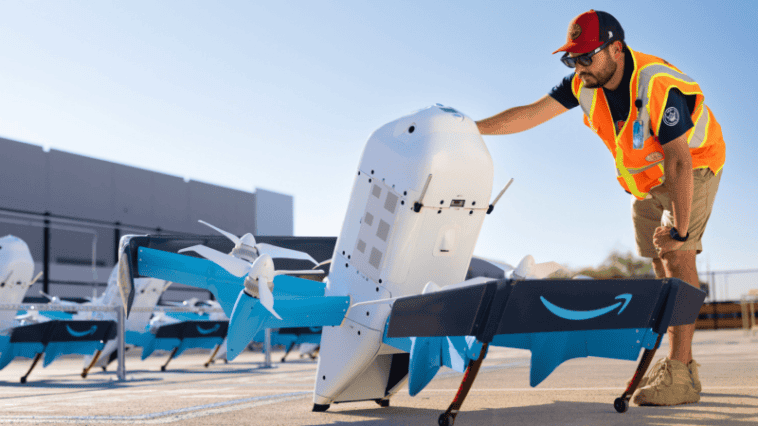
A Richardson, Texas, resident who has been tracking the flights since early this year told the City Council in February that she had logged 122 drones over her home in one day and more recently counted 52 on a Friday she described as slow.
Three of those drones flew between 150 and 170 feet up, while Amazon’s drones are supposed to stay at an average of 225 feet, with 400 feet being the maximum altitude allowed under FAA rules.
Prime Air has operated out of Richardson since 2025, offering more than 60,000 items from a local facility in an hour or less. Amazon plans to expand the service to more cities this year. “We are always exploring new ways to get customers a wider selection at faster speeds,” Amazon spokesperson Cait Freda said in an April statement to The Dallas Morning News when talking about Amazon’s plans to expand drone service across the Dallas-Fort Worth area.
What the drones store and see
The drones in question, Amazon’s newer MK30 model, weigh about 80 pounds each and carry packages up to five pounds, flying roughly 7.5 miles from their base.
The noise drove dozens of residents to voice their complaints in a Richardson City Council meeting in March to demand local limits on flights. Amazon, however, pointed to shopper demand as proof the service is working. “The response from customers using Prime Air has been overwhelmingly positive,” Freda remarked in April.
Deliveries currently operate from 7 a.m. to 8 p.m. under city rules, but neighbors lobbying for shorter hours say federal aviation regulators have left them without recourse. The cameras are a separate fight.
Richardson officials insist that the drones don’t take photos or record video, stating that “the drones operate autonomously and use low-resolution camera sensors solely for navigation and safety purposes,” according to an FAQ on the city’s website.
Amazon’s Prime Air page says something else entirely: “People, pets, cars, and objects near the delivery or landing location may be recorded when the drone is completing the delivery process or landing. In some cases, drone cameras may collect images that include you if you are near the delivery or landing location.”
An Amazon spokesperson told The New York Times that such images are stored on encrypted drives that only authorized staff can access. Households can request an opt-out for their address.
Still, some Richardson residents have written to officials in El Paso and Richmond, Virginia, two cities where Amazon plans to expand next, warning them before the drones arrive. One email sent by a resident called the service “a disaster for the City of Richardson.”
Amazon, however, says Richardson is an outlier that happens to sit right next to a delivery hub, so it gets the heaviest takeoff and landing traffic.
Even so, drone traffic will likely only surge moving forward. There are currently close to 900,000 registered drones in the U.S., a figure the FAA projects will reach 3.5 million by the end of the decade.
Sources: City of Richardson, FAA, Amazon, The Street, NYT, Dallas News