
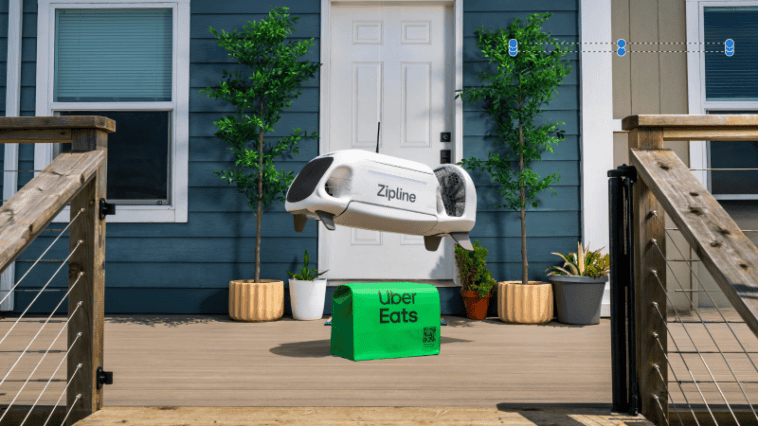
Uber recently announced that it has entered a partnership with Zipline to begin delivering food by drone this year, along with a strategic investment that the company declined to disclose. The deal is designed to help Uber hit a goal of one million drone deliveries a day by the end of 2029.
Flights will begin before the end of this year in the U.S. markets where Zipline already operates, with plans to expand into dozens more cities as the service scales.
Zipline flies fixed-wing drones that drop packages by parachute. Uber thinks that the setup can get an Uber Eats order to a customer in five to ten minutes. “Truly quick commerce is proving to be an even bigger market than the original food market was,” Uber CEO Dara Khosrowshahi said in a joint statement. “We think this can be an enormous tailwind for the next leg of growth for Eats,” Khosrowshahi added.
The scale behind the sky
Zipline, based in San Francisco and operating on four continents, has completed more than two million deliveries so far. An extended $800 million Series H funding round recently pushed its valuation to $7.6 billion. The company’s partners include Walmart along with more than a dozen restaurant chains, with Panera, Chipotle, and Wendy’s among them.
“Every great transportation revolution has changed where people live, how businesses operate, and how economies grow,” said co-founder Keller Cliffton. “Together with Uber, we’re taking the next step toward building a world where getting what you need is as fast and effortless as sending a text, no matter where you are,” Cliffton added.
Uber, however, gave up building this kind of hardware years ago. It sold off its aerial ride-sharing unit, Uber Elevate, and its Autonomous Technologies Group, which had been developing self-driving vehicles in-house. Since then, the company has invested more than $10 billion into dozens of autonomous vehicle providers, betting that its massive user base matters more than owning the underlying tech.
The approach has produced some friction. Uber and Waymo, partners in robotaxis, are reportedly expected to part ways when their contracts expire in 2028, and the two currently sit on opposite sides of a regulatory fight over autonomous vehicle rules.
Speaking of which, drones aren’t new territory for Uber either. Elevate looked at aerial logistics before it closed, and late last year the company took a small stake in Flytrex, a startup focused on suburban food delivery. Zipline is a considerably larger commitment, however.
A million deliveries a day would dwarf current global drone delivery volumes, but scaling to such volumes will require more movement on beyond-visual-line-of-sight flights and urban airspace management, areas where the FAA has been opening commercial operations only gradually.
Sources: Uber, Zipline, BigGo Finance