
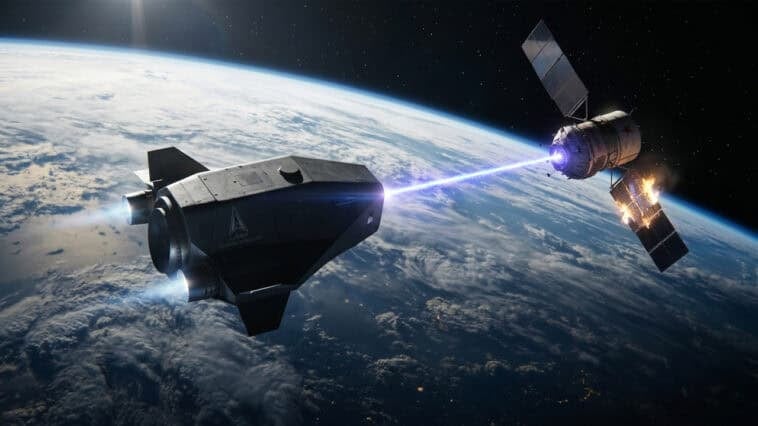
The U.S. military has confirmed something that had previously been kept out of the public spotlight: weapons are already deployed in space. Air Force Secretary Troy Meink said the Space Force has “on-orbit space control weapons” capable of defending American forces against hostile actions, marking the first public acknowledgment of such systems. The announcement comes as military competition in space continues to grow, particularly as the U.S. and rival powers develop technologies designed to disrupt or counter satellites. But what exactly are these weapons, what can they do, and why is Washington revealing their existence now?
Space Force confirms weapons are already in orbit
Speaking at the Air & Space Forces Association’s annual conference in National Harbor, Maryland, Air Force Secretary Troy Meink delivered a statement that instantly shifted the landscape of international security.
“Today we continue to ensure we remain ready to meet the challenges of evolving threats wherever they exist,” Meink told the assembled crowd. “This is why the United States now has on-orbit space control weapons capable of defending the joint force against hostile adversary action.”
The announcement marks the very first time Washington has publicly confirmed having operational offensive or defensive military capabilities stationed directly in orbit. Beyond acknowledging their existence, however, Meink kept his cards close to his chest. He declined to elaborate on the exact nature of the technology, how many systems are currently deployed, or when they were placed into space.
The double-edged sword of weapons disclosure
While the announcement serves as a clear warning to foreign adversaries, military experts note that keeping the details strictly classified could dilute its intended impact.
Clayton Swope, deputy director of the Aerospace Security Project at the Center for Strategic and International Studies and a former CIA official, emphasized that deterrents require clarity to work effectively.
“The disclosure is still significant because it’s not something that we have talked about in this way,” Swope noted. However, he cautioned that secrecy limits strategic leverage. “You really have to think out this chain of logic beyond just this disclosure.”
For a threat to truly deter hostile behavior, Swope explained, potential rivals must grasp “what exactly is the destructive potential of this weapon, and then what exactly don’t we want them to do—so that by knowing that, they don’t do it.”
Rising tensions fuel a new race for weapons in space
The decision to reveal these capabilities comes amid accelerating military rivalries above the atmosphere. Since the establishment of the U.S. Space Force in 2019, American officials have repeatedly warned that both Beijing and Moscow are aggressively expanding their counterspace arsenals.
According to official Space Force assessments, Beijing actively integrates counterspace capabilities into its broader military modernization strategy, while Moscow views orbital supremacy as a decisive factor in modern warfare. U.S. intelligence has tracked Russian satellite maneuvers that simulate tactical space combat, as well as China’s development of fractional-orbit hypersonic weapons.
While the 1967 Outer Space Treaty strictly bans placing nuclear warheads or weapons of mass destruction in orbit, it leaves a significant legal loophole: it does not prohibit conventional weapons stationed in space or ground-launched anti-satellite hardware.
This ambiguity opens up a wide spectrum of possibilities for what the U.S. may have deployed. Potential systems range from high-powered jamming satellites designed to blind enemy communications to space-to-ground precision weapons.
Another possibility is a co-orbital anti-satellite (ASAT) system — a spacecraft capable of maneuvering close to an adversary’s satellite to disable or destroy it. While the U.S. pledged in 2022 to end testing of ground-launched “direct-ascent” missile strikes on satellites to prevent dangerous orbital space debris, that pledge does not rule out co-orbital defenses.
“Dating back to the Soviet Union and the Cold War, the Russians have been interested in developing what I would call ‘co-orbital, anti-satellite’ weapons,” Swope added. “These are satellites that would launch some type of projectile or other munition at the target satellite to disable it.”
Why the fight for control of space matters on Earth
The urgency driving these orbital deployments stems from the sheer vulnerability of modern infrastructure. Today, global commerce, emergency response networks, banking systems, and everyday GPS navigation all rely heavily on satellite constellations.
Concerns spiked following reports that Russia has explored developing space-based nuclear capabilities designed to trigger sweeping electromagnetic pulses (EMP), a move that could indiscriminately fry civilian and military networks alike.
“It is critically important that we maintain our dominance not only in the air but in space, and so we’ve had to take steps to make sure that when we’re threatened, we can take care of that,” Meink said.
This strategic push aligns with broader initiatives to construct next-generation orbital defenses, including proposed space-based interceptor networks capable of neutralizing incoming missiles mid-flight. Highlighting the speed of these developments, Meink revealed that one key space-based interceptor initiative has already moved “from initial contract to flight-ready hardware in less than one year.”
As space transitions from a high-altitude frontier into an active operational domain, Washington’s quiet disclosure confirms a new reality: the battle to protect everyday life on Earth is now actively being fought in orbit.
Source:
CNN