
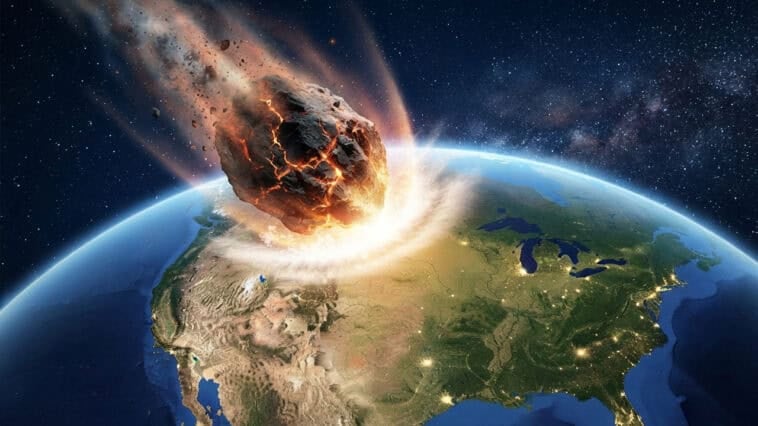
A massive asteroid impact may have left behind more than just a giant crater beneath Oklahoma. It could also be connected to one of the most devastating extinction events in Earth’s history. Scientists have recently reexamined the Ames crater and discovered that it formed around 370 million years ago, nearly 100 million years later than earlier estimates suggested. The new timeline places the impact close to a period when marine life suffered a major decline, raising questions about whether the collision played a role in the ancient catastrophe. But what exactly happened when the asteroid struck, and how could a crater buried deep underground help explain the disappearance of so many species? Read on to discover what researchers have uncovered.
Beneath the small Oklahoma town of Ames lies an enormous reminder of an ancient asteroid impact. Measuring approximately 10 miles (16 kilometers) across, the Ames crater is buried under nearly 9,000 feet (2.7 kilometers) of sedimentary rock, making it invisible from the surface.
Scientists first discovered the structure in 1991 after seismic readings revealed unusual formations deep underground. However, determining when the asteroid struck proved more difficult.
Early estimates placed the impact at around 467.5 million years ago, during the Ordovician period. Researchers based this timeline partly on a fossilized tooth found in rock inside the crater. The tooth belonged to a conodont, an ancient eel-like marine creature.
At the time, the estimated age appeared to match a major asteroid bombardment known as the Ordovician Meteor Event. Around 467.5 million years ago, nearly two dozen impact craters formed around the world, most within 30 degrees of the equator. Scientists have suggested that a large asteroid broke apart, creating a ring of debris around Earth before fragments eventually struck the planet.
However, new research suggests the Ames crater formed much later.
New dating places the impact 370 million years ago
A research team led by Elizabeth Catlos of the University of Texas at Austin has determined that the crater is approximately 370 million years old, nearly 100 million years younger than previous estimates.
This revised timeline places the impact close to the Late Devonian mass extinction, also called the Frasnian–Famennian boundary extinction. This event occurred around 372 million years ago and caused a significant decline in marine life.
The discovery changes how scientists understand the crater’s place in Earth’s history. Instead of belonging to the Ordovician asteroid bombardment, it may be connected to a much later period of environmental upheaval.
“With this research, we’re basically taking a major pawn out of the Ordovician Meteor Event and dumping it into the Frasnian–Famennian event and saying, ‘this is where this impact belongs’,” said Catlos in a statement.
Tiny crystals reveal the crater’s true age
To establish when the asteroid struck, researchers examined microscopic zircon crystals found inside the crater.
Zircon is a durable mineral that can preserve geological evidence for billions of years. Scientists can determine its age by measuring the amounts of uranium and lead trapped inside it. When zircon forms, it generally excludes lead, but radioactive uranium gradually decays into lead over time. By measuring these elements, researchers can estimate when the crystals originally formed.
The enormous heat and pressure generated by the asteroid impact would have created new zircon crystals, allowing scientists to date the collision.
Working with researchers at NASA’s Johnson Space Center, Catlos’ team used two advanced imaging techniques to examine the minerals: cathodoluminescence and electron backscatter diffraction. The first uses an electron beam to make materials emit light, while the second uses a scanning electron microscope to study their internal structure.
Both methods produced the same younger age estimate.
“No matter what technique we used, it was coming back to this younger signal,” said Catlos.
The discovery also helps explain why the fossilized conodont tooth initially suggested an older age. Researchers believe the tooth was already present in the surrounding rock before the asteroid struck. The violent collision likely scattered older materials into the crater, making the fossil an unreliable indicator of the impact’s age.
Could the impact have contributed to an extinction?
Although the crater’s new age places it close to the Late Devonian extinction, scientists do not believe the asteroid impact was powerful enough to cause the event on its own.
Instead, it may have contributed to environmental changes that were already threatening marine ecosystems. Other possible explanations include declining oxygen levels in the oceans, massive volcanic eruptions, and even a nearby supernova. Researchers have also considered whether several events occurred together.
More evidence is needed to determine whether the Oklahoma impact played a significant role in the extinction or happened around the same time.
The new dating and other related findings were published in July in the journal Meteoritics and Planetary Science.