
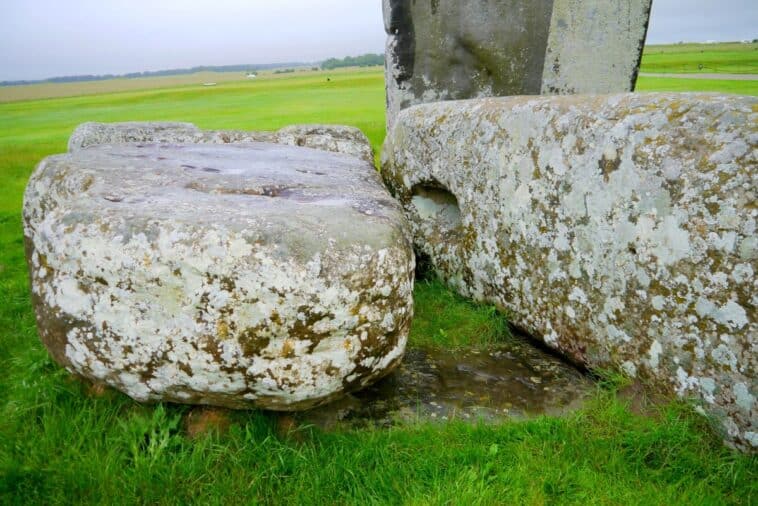
Researchers trying to find out where Stonehenge’s six-ton Altar Stone came from, after recent tests revealed the megalith was transported from Scotland, not Wales, have checked a series of likely spots in northeastern Scotland and come up empty.
The sandstone slab sits in the middle of Stonehenge, the prominent prehistoric stone circle in southwestern England, partly buried under the collapsed stones of the Great Trilithon.
For a century, following a landmark 1923 paper by geologist H.H. Thomas, scientists thought it had been hauled from western Wales alongside the monument’s smaller bluestones.
That changed in August 2024, when a landmark study in the journal Nature analyzed the slab’s unique mineral fingerprint and traced it to northeastern Scotland.
This time, in the investigation, a team led by geology professor Duncan Pirrie of the University of South Wales sought to locate the specific source. They studied the stone at the site and pieces of it kept in museums, then compared it with rock from the Orcadian Basin in northeastern Scotland, the area that had seemed most promising.
“This is the most comprehensive geological investigation of the Altar Stone ever undertaken. By combining a wide range of analytical techniques, we have built the clearest picture yet of the stone’s composition and tested the leading theories about its origins,” Pirrie said in a statement.
“So far, none of the locations examined have the same set of characteristics as the Altar Stone. That tells us the search is not over, but we are now far better equipped to focus on the areas most likely to yield an answer,” the professor added.
The work, published in the Journal of the Geological Society, gives researchers a clearer list of what a match should look like. That should make it easier to know where not to look. “In a geological detective story such as this, ruling out potential source areas is just as important as identifying new ones,” said Nick Pearce of Aberystwyth University in a statement.
Ultimately, the answer matters because the stone’s true origin reveals the advanced capabilities of the people who built Stonehenge between about 3000 and 1600 B.C. The bluestones traveled around 140 miles from Wales. A stone from northeastern Scotland would have had to go a lot farther (more than 460 miles at least) to reach the site, likely by sea.
Study co-author Richard Bevins, an honorary geology professor at Aberystwyth University, said in a statement that the team is gaining ground with every test: “With each new piece of evidence, we move closer to solving one of Stonehenge’s most enduring mysteries.”
Sources: Journal of the Geological Society, Aberystwyth University, ScienceDaily