
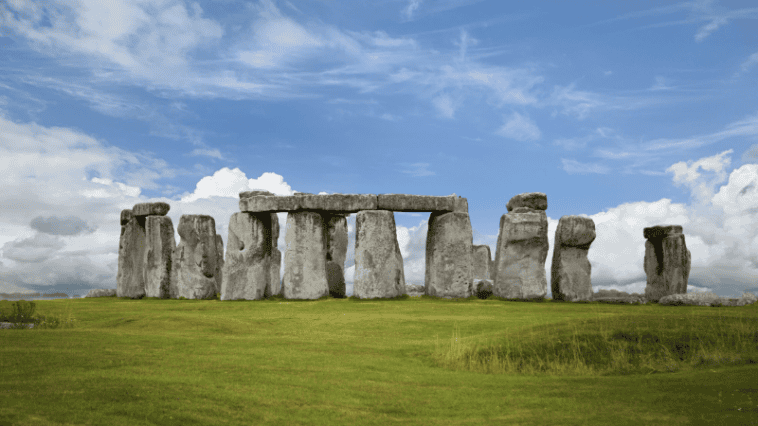
Stonehenge might have been a sports arena. Or close to it. English Heritage curator Win Scutt, who looks after the monument, has suggested that the stone circle was a kind of Stone Age competition venue and that hauling the stones into place may itself have been part of the contest.
The monument was built in stages over roughly 1,500 years, beginning around 3,000 BC, on Salisbury Plain in Wiltshire. It’s arguably the most famous prehistoric site on Earth, and almost everything about it, who built it and why, continues to be the topic of debate.
Theories have ranged from it serving as a cemetery or healing center to an astronomical observatory, since the circle’s main axis aligns with the summer and winter solstices.
Scutt’s version is a bit different. The curator thinks it could have worked like a Stone Age Olympiad, where people went head-to-head in tests of strength and skill. “I think there were probably games, just like the Panhellenic Games,” he told The Times of London.
Why the pig bones matter
What helped convince Scutt about his theory is the evidence from the animal bones. Archaeologists dug up huge quantities of pig bones at the site, and a lot of them came from far away. The pattern suggests that crowds traveled from across the UK to be there, the kind of turnout you’d expect for a big event rather than a quiet ceremony.
The competition angle might even explain the stones themselves. The largest sarsens weigh roughly 25 tons and were moved from Marlborough Downs, about 15 to 20 miles away. The six-ton Altar Stone came from much, much farther, more than 430 miles away in northeast Scotland. Moving rock like that is a staggering effort, and rivalry would have given people a reason to pull it off.
Scutt further noted that the rivalry would have been sharper still if the builders “were coming from different areas.” He pointed to signs of “organized gang work” at Durrington Walls, a settlement about two miles away where the builders are thought to have camped.
The curator’s theory finds support from archaeologist Luke Winter, who also doesn’t buy the idea that Stonehenge was built out of pure “goodwill.” Commenting on the motivation behind large-scale Neolithic construction, Winter said, “It’s not just a group of mates coming together. If there’s a little bit of edge, of competition, that’s going to help.'”
A full-size Neolithic building, rebuilt
The theory emerged around the same time that English Heritage unveiled a recreation of a prehistoric structure. It’s called the Kusuma Neolithic Hall, put up by 100 volunteers using local materials and period-accurate methods, right down to the flint axe, based on what was found at Durrington Walls, according to the BBC.
“This is the first building of this type, it’s definitely epic,” said Winter, who ran the project. The hall will be used to teach visitors about life in the third millennium BC. That build, the researchers figure, was probably a more cooperative affair than Stonehenge ever was.
The Two-Mile Earthwork
The game theory is far from settled, but it might shed light on the Stonehenge Cursus, a nearly two-mile earthwork sitting just north of the stone circle, per the Telegraph.
People once took it for a Roman race course. Scutt thinks it may have been a “place of gathering, display, movement and performance, perhaps even competition.” One of his guesses is that it was used for deer coursing, a brutal pastime where hounds are set loose on game animals for the entertainment of a crowd.
Source: NY Post