
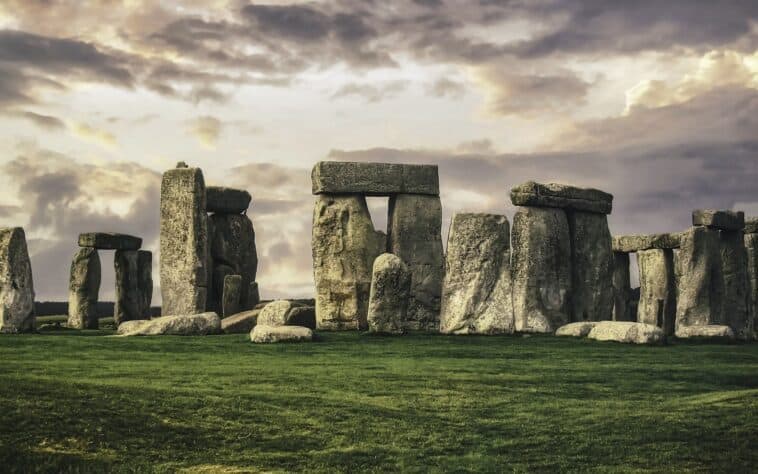
One of the greatest head-scratching puzzles in human history may have been solved thanks to researchers from Curtin University in Australia. The scientists say they have found answers as to how Stonehenge’s Altar Stone arrived at the iconic historic site.
Theories surrounding Stonehenge’s Altar Stone
Stonehenge itself is filled with many mysteries but the Altar Stone’s origin has been a major point of contention. Researchers have come up with several theories as to how the 13,000-pound stone was hauled to its final resting place.
Just as the origin of the stone remains contentious, so too remains its mode of transportation. Given that the huge boulder was added to the historic site between 2620 and 2480 B.C., scientists have wondered how a 16-foot, 6.5-ton rock traveled such a great distance at a time when there wasn’t much technology around.
Some scientists say Neolithic people from quarrying sites brought the Altar Stone to the monument via a combination of land and sea travel. Some have credited environmental changes while others have favored glacial movements.
Curtin University researchers say they have the answers
Many theories have emerged showing that the Altar Stone, Stonehenge’s centerpiece, may have originated from Wales. However, the researchers cracked the cold case when they gave the Altar Stone a high-tech geological DNA test—proving that it came from Scotland.
They fired a microscopic laser at the rock to vaporize a tiny speck of dust, then used a specialized machine to read the radioactive “atomic clocks” ticking inside the stone’s microscopic crystals. Because every bedrock region on Earth has its own unique age profile, this process read the stone’s history—tracking its exact origin straight to northeast Scotland
The Australian researchers have found that not only is the Altar Stone’s presence at the site a result of human effort, but also the culmination of a carefully planned endeavor.
According to the research’s co-lead author Dr. Anthony Clarke of Curtin’s School of Earth and Planetary Sciences, evidence points to a deliberate and carefully planned movement across rough terrains and hostile environments.
“Transporting a stone of this size over such a long distance would have required planning, coordination and a deep understanding of the landscape—not to mention tremendous determination,” Clarke said in a statement.
The new research contradicts glacial transport
Previous researchers believed the glacial transport phase began the journey. Shifting ice-sheet vectors during the last glaciation may have moved the stone from its source in Caithness, Scotland, southeastward toward Dogger Bank.
However, Clarke’s team noted that Dogger Bank was submerged by rising sea levels 3,000 years before Stonehenge was even built. This massive time gap led the authors to conclude that the stone’s journey was entirely a human-led effort from Scotland to England. The researchers concluded that the Altar Stone was likely transported via coastal and river boat routes.
According to Clarke, Stonehenge’s builders didn’t have a set deadline like modern projects. As a result, the historic monument was a highly organized, multi-generational societal effort that took centuries to create.
A triumphant team effort
By demonstrating that the Altar Stone’s journey was an intentional human endeavor, Clarke and his colleagues have shown the profound determination of Stonehenge’s builders.
This multi-stage voyage reveals that despite harsh environments, Neolithic people possessed the advanced planning, coordination, and resourcefulness necessary to complete this monumental prehistoric endeavor.
Sources: New York Post, Wiley Online Library