
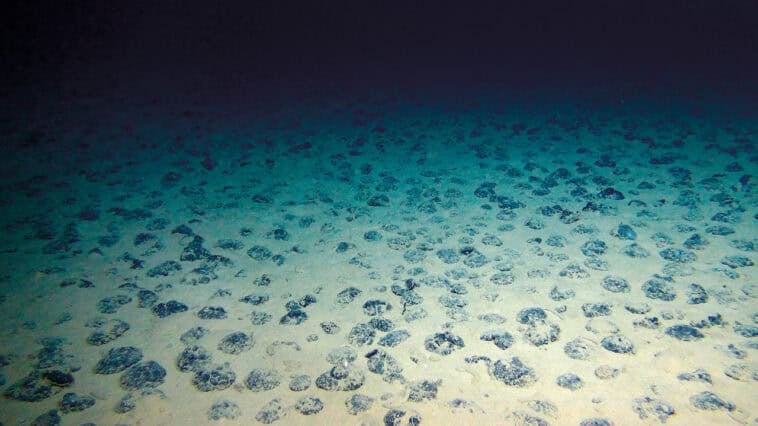
For decades, scientists have believed that sunlight is essential for producing oxygen through natural processes in the ocean. But a remarkable discovery beneath the Pacific Ocean could turn that understanding upside down. Researchers have found millions of metal-rich rocks on the deep-sea floor that may generate enough electricity to produce oxygen in places where sunlight never reaches. Could these ancient rocks hold the secret to an entirely new way oxygen is created? Keep reading to find out what scientists uncovered.
A mystery four kilometers beneath the waves
In 2012, deep-sea ecologist Andrew Sweetman lowered scientific instruments 4,000 meters (about 2.5 miles) into the Pacific Ocean and recorded data that defied basic marine biology. Instead of dropping as seabed creatures consumed it, oxygen levels in the water appeared to climb. At that crushing depth, where temperatures hover near freezing and sunlight never penetrates, photosynthesis is impossible.
Sweetman, a researcher at the Scottish Association for Marine Science, initially blamed faulty sensors. Yet the baffling readings persisted across multiple expeditions, even after he swapped equipment and double-checked the water using chemical tests.
The data came from the Clarion-Clipperton Zone, a vast expanse of ocean floor between Hawaii and Mexico. In 25 seafloor chamber experiments detailed in a 2024 Nature Geoscience study, oxygen levels started at an average of 185 micromoles per liter and surged as high as 819 micromoles per liter within 47 hours. Follow-up lab tests with filtered seawater convinced Sweetman’s team that simple sensor glitches or outside leaks couldn’t explain the spike.
The clue to the puzzle came nearly a decade after those first readings, via a television documentary playing in a São Paulo hotel bar. The program referred to the potato-sized metallic rocks carpeting the Pacific seabed as a “battery in a rock.” Sweetman wondered if these mineral deposits were generating electricity to produce what researchers now call “dark oxygen”, which is basically oxygen created without sunlight.
A $50 voltmeter sparks a breakthrough
The seabed in the Clarion-Clipperton Zone is blanketed with polymetallic nodules, which are rounded rocks packed with manganese, iron, cobalt, nickel, and copper. In November 2022, Sweetman reached out to Franz Geiger, an electrochemist at Northwestern University who studies how metals interact with saltwater to produce electrical charges.
Geiger doubted deep-sea rocks could generate enough power to trigger a chemical reaction, expecting any charge to be microscopic. However, when he tested the nodules, the readings shocked him. According to Popular Mechanics, Geiger assumed he would need ultra-sensitive instruments, only to discover that an ordinary $50 hardware-store voltmeter could detect the charge.
Tests revealed voltages reaching up to 0.95 volts across the surface of individual nodules. While impressive, that figure falls just short of the 1.23 volts typically needed for electrolysis, which is the chemical process of using electricity to split water molecules into hydrogen and oxygen. Sweetman proposed that clusters of nodules touching one another on the seafloor might act together like batteries wired in series, pooling enough electrical power to split seawater.
Millions of years in the making
Polymetallic nodules are among Earth’s slowest-growing geological structures, adding just a few millimeters of thickness every million years. They form around tiny bits of ocean-floor debris (Geiger even found an ancient shark tooth preserved inside one specimen), building up concentric mineral layers much like the rings of a tree.
Because ocean chemistry shifts over millennia, each layer carries a slightly different mix of metals. One ring might be rich in manganese, while the next holds more nickel or cobalt. That uneven layering intrigues electrochemists, as pairing different metals in saltwater naturally creates electrical potential.
Still, not every nodule shows the same charge, and having layered metals does not automatically make a rock a working oxygen factory. The stakes for figuring it out are high: mining companies are eager to harvest these nodules for the metals needed in electric vehicle batteries. If the rocks also supply life-sustaining oxygen to deep-sea ecosystems, mining them could cause unforeseen ecological damage.
Putting the theory to the ultimate test
Not everyone in the scientific community is convinced. Critics have suggested the strange oxygen spikes could stem from trapped air bubbles or experimental errors rather than a natural geobattery. In April 2026, Nature Geoscience added an editor’s note to the original paper noting that those concerns are under review, and a September 2026 reanalysis found no clear statistical link between nodule size and oxygen increases in the earlier experiments.
Sweetman stands by his team’s findings and is preparing to settle the debate with purpose-built technology. Backed by the Nippon Foundation’s Dark Oxygen Research Initiative, engineers built two deep-sea landers named Alisa and Kaia, designed to withstand depths of up to 11 kilometers.
Unlike older gear, these landers can simultaneously measure oxygen, pH levels, and hydrogen, since splitting water through electrolysis should release both hydrogen and oxygen. With Kaia already shipped out for a new expedition to the Clarion-Clipperton Zone, scientists hope to soon confirm whether the deep Pacific is truly powered by ancient rock batteries.
Source:
Daily Galaxy