
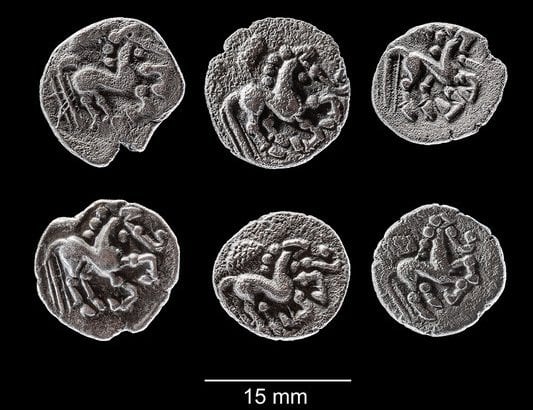
A small hoard of Celtic silver coins has been found under a former sports field in Germany, and it’s the largest of its kind ever discovered in the state of Thuringia.
Archaeologists from Thuringia’s State Office for Monument Preservation and Archaeology (TLDA) were surveying the site in the village of Singen (nestled below the Singer Berg hill in central Thuringia), ahead of plans to build a new fire station, when excavation director Ronny Krause came across the coins.
The team returned for more digging in August and recovered 11 in all.
The coins date to the first century B.C. and are a type of Celtic money known as Prague-type quinarii. The TLDA said only about 80 of these coins had been found across the state before this discovery. Experts believe they were made at a mint in the Gotha region.
Whoever buried the coins likely kept them together in one container, which rotted away long ago. Plowing later scattered them across part of the field, but the team believes that they recovered every coin from the original hoard.
“Through the ongoing mapping of discoveries from the same period and cultural background, researchers can draw conclusions about ancient trade routes and production centers,” the office noted.
Several other objects, unrelated to the Celtic hoard, also turned up during the excavation, including a Roman coin, a medieval glass bead, a knife fragment, an additional silver coin, and a Prussian uniform button.
The TLDA also emphasized that the find demonstrates why it matters to record exactly where artifacts are found, warning that coins taken from the ground by people using metal detectors without documenting the location lose much of their value to researchers.
Sources: Thüringisches Landesamt für Denkmalpflege und Archäologie
(TLDA), Herder, NYP