
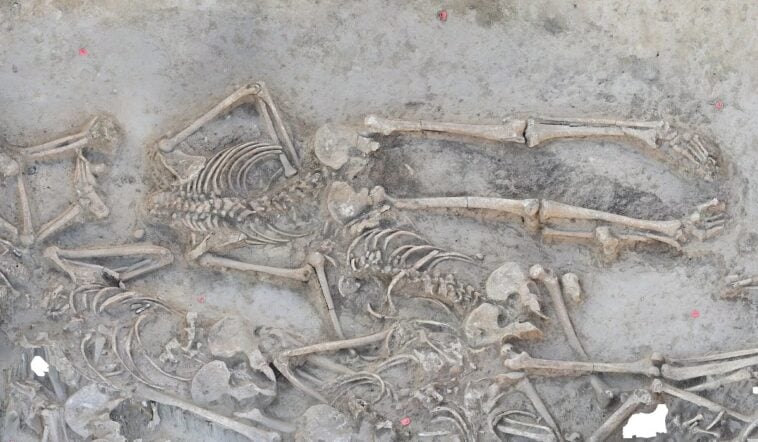
In a 2022 excavation of a Slovakian pit, archaeologists uncovered the remains of 78 people, 77 of whom shared an oddly macabre and mysterious trait: they were headless. Seven thousand years after the fact, scientists are now using new analysis to understand why someone made off with nearly every skull, leaving only one child’s remains intact.
The write-up recently appeared in The Prehistoric Society’s annual peer-reviewed journal, The Proceedings of the Prehistoric Society (PPS).
The paper’s lead author, Kiel University professor Martin Furholt, struck a cautious tone. ‘We must assume that these practices were embedded in completely different contexts of meaning than those of modern societies,’ he told Popular Mechanics.
How it all started
Back in 2022, archaeologists were working at the long-term Vráble-Veľké Lehemby excavation site in Slovakia that stretched back roughly 7,000 years to a group called the Linear Pottery Culture, or LBK, one of Europe’s earliest farming groups.
The project was a joint international partnership between Kiel University and the Slovak Academy of Sciences, which has spent years examining the site’s complex layout.
This particular Neolithic spot was found to be unusually large, consisting of over 300 house layouts in total, with about 80 of them occupied at the community’s peak.
Buried beneath it all was the strange discovery of a mass grave containing a pile of 78 skeletons stacked atop one another. Every one of them was missing a head, except for a single child whose skull was still attached and whose body had been carefully placed among the adults.
The first and most natural assumption for the state of the mass deposit was possibly war, sacrifice, or something else equally violent. “It may seem obvious to assume a massacre with human sacrifices, perhaps even in connection with magical or religious ideas,” said Maria Wunderlich, who led the Kiel University project, in a 2023 university statement.
What the bones revealed
The bones told a different story once they were examined properly, however. Far from a slaughter, Furholt and his team concluded that this was a ritual of some kind, just one whose meaning is long gone.
The evidence pointed away from violence, as the cuts on the bone weren’t the rough hacks you’d expect from a battle or an execution. They were clean and were made with sharp tools by someone who knew what they were doing.
“The features clearly exhibit an intentional manipulation of the bodies,” explains Katharina Fuchs, a biological anthropologist at the Institute of Pre- and Protohistoric Archaeology at Kiel University and co-author of the study, in a statement.
Missing jawbones added another layer to the mystery. None were found in the pit, implying that the heads had been taken whole and handled with patience. The same careful approach was shown in the neck vertebrae, which lay nearby along the ditch wall. They had been removed one by one, pointing to deliberate, unhurried work rather than the frenzy of combat.
From there, the evidence has sparked multiple interpretations. The heads may have been taken as trophies in some form of head-hunting or, more likely, in the eyes of many researchers, kept as part of rituals honoring the dead, such as ancestor veneration, with the skulls kept close and the rest buried elsewhere.
It’s worth noting that sites like these are not an isolated case. Headless graves keep popping up across Neolithic Europe, and the team writing this paper sees enough of them to call post-mortem decapitation a fairly normal practice of the period.
Reading the meaning behind the site today, Furholt admitted, is the part that remains challenging. The belief system that once made sense of all these practices may have long been buried with the people who held it. Still, the team’s work is far from over.
The researchers plan to analyze the bones and any associated artifacts that have been buried with them in further detail, hoping to learn more about the relationships between these individuals and the events that led to their deposition in the grave.
Sources: Cambridge Core, Kiel University, 2023 Kiel Press Release, NYP