
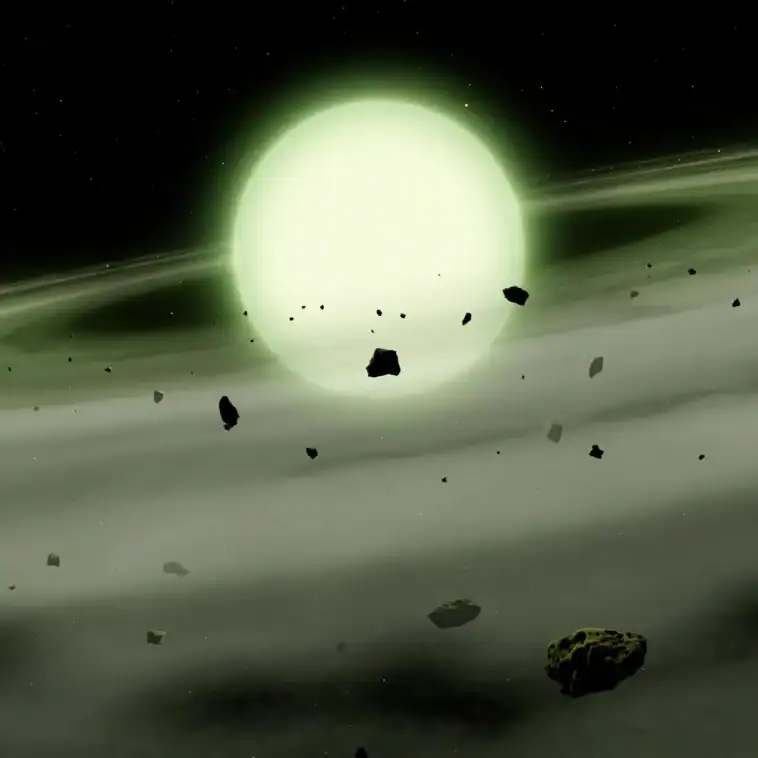
Forget about spooky green zombies shuffling around on Halloween. The real sci-fi magic is happening hundreds of light-years away in deep space. Stellar scientists have just identified the universe’s very first known green star, proving that the cosmos is a whole lot more colorful than anyone previously imagined.
Breaking the cosmic color rules
For generations, astronomers relied on a simple rule when looking at stars: color is all about temperature. Cool stars glow orange, sun-like stars shine white and ultra-hot stars burn a pale blue, much like a blacksmith’s iron changing colors as it heats up. Researchers always assumed that white dwarfs, the dense stellar corpses left behind when sun-sized stars run out of fuel, followed this exact rule.
However, a team led by researchers at the University of Warwick decided to look closer at what happens when these incredibly dense remnants interact with their surroundings. Because white dwarfs pack immense mass into a tiny space, elements like carbon, calcium, and sodium behave differently under extreme pressure. Instead of acting like perfect temperature radiators, these dense stars can produce an unexpected rainbow of hues, ranging from pink and cyan to deep purple.
Meet the ultimate cosmic cannibal
The crown jewel of this colorful discovery is a cool white dwarf designated as WD J1330+6435, located roughly 326 light-years away from Earth. This stellar corpse has been actively snacking on nearby rocky planets and asteroids like a cosmic zombie, pulling debris into its atmosphere.
That planetary snack is precisely what gave the star its spooky shade. The traces of sodium whipped into its dense atmosphere absorb the orange part of the light spectrum, leaving behind a ghostly and vibrant green glow.
The implication of finding the rarity
While researchers estimate that only about one in thirty white dwarfs sport these unusual colors, with most staying stubbornly white, finding a genuinely green star proves that reality can easily beat science fiction. Standing on an alien world and looking up at an emerald sun might sound like a Hollywood movie set, but thanks to this stellar zombie, it is officially real astronomy.