
If you have taken a glance at a parched riverbed lately, you might have figured things were getting a bit dry. But a sobering update—one that we could say calls for deep reflection—from space reveals that the situation happening right beneath our feet is far more serious than we realized.
NASA scientists have uncovered a massive, hidden global water crisis unfolding across the planet. With the aid of high-tech satellite observations and by drastically sharpening how they analyze data collected from orbit, researchers discovered that freshwater, including surface water like lakes, rivers and underground aquifers, is dropping at speeds far beyond earlier estimates. This is especially true in areas that suffer from massive drought.
Weighing Earth’s water supply from space
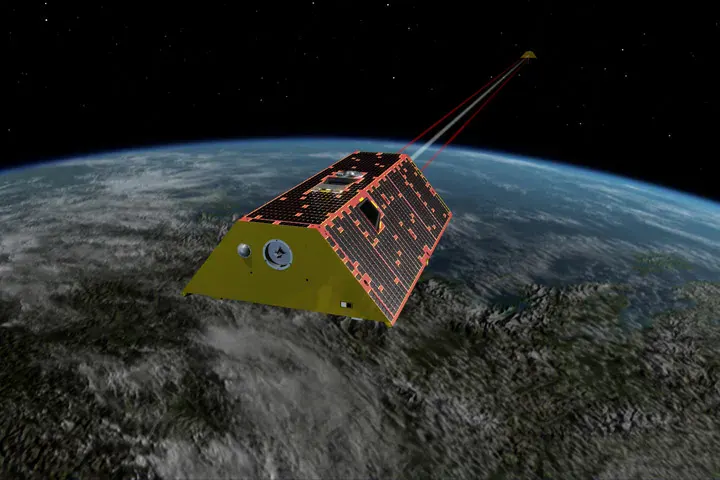
So, how exactly does NASA track underground water levels without digging a giant hole? It weighs it from space using the GRACE (Gravity Recovery and Climate Experiment) satellite. Grace is a joint program operated by NASA, German Aerospace Center and German Research Centre for Geosciences.
The original GRACE satellites (2002 to 2017) and their follow-up, the GRACE–FO (GRACE–Follow On 2018 till date) satellites measure fluctuations in Earth’s gravity on monthly scales. Because water has mass, shifts in terrestrial water storage create tiny, measurable changes in gravitational pull as the spacecraft pass overhead. By tracking those microscopic gravitational pulls, scientists can measure changes in soil moisture, lakes, rivers, and deep underground aquifers.
Hidden depletion in global hotspots
The findings of this latest study, led by author Mary Michael O’Neill and her team, were published in the journal Proceedings of the National Academy of Sciences.
Historically, traditional analysis methods smoothed out regional details because they couldn’t reliably detect changes in areas smaller than roughly 58,000 square miles. By applying an innovative “stacked” regression technique to data gathered between April 2002 and November 2025, the team produced a trend map with five to ten times the spatial resolution of older maps.
Across global hotspots, groundwater depletion turned out to be drastically worse than previous studies estimated. When rain fails to fall or reservoirs run low, farms and growing cities pump massive amounts of water directly out of deep underground aquifers.
“The regions of greatest concern are those already recognized as water-stressed, where we now observe losses even greater than previously estimated,” said O’Neill.
O’Neill and her colleagues estimate global total fresh9FFwater withdrawals to be anywhere from 3,800 to 5,000 gigatons per year.
Agriculture and climate are driving the steepest losses
Unsurprisingly, heavy agricultural pumping and human activity are driving the steepest declines. Warmer ocean temperatures and changing weather patterns have altered rainfall globally, leaving long periods between intense precipitation events.
“Warming temperatures increase both the evaporation of water from the surface to the atmosphere, and the water-holding capacity of the atmosphere, increasing the frequency and intensity of drought conditions,” said NASA Goddard meteorologist Michael Bosilovich in a 2024 report.
According to Bosilovich, when extreme downpours do happen, dry soil cannot absorb the water quickly enough, causing it to run off instead of replenishing underground reserves. The resulting reduction in available water puts a severe strain on communities and ecosystems worldwide, proving that our planet’s vital liquid assets are disappearing faster than ever.